
Datto RMM + DeskDay is live now! If you're a Datto RMM user, sign up today to claim your free trial Get Started

 Team DeskDay Team DeskDay
Level 1 techs live in the gap between urgency and chaos.
On any given day, a single L1 tech might be juggling 15–25 tickets: password resets, printer issues, VPN failures, new-hire setups, “Teams isn’t working,” and the occasional full-blown outage.
Each ticket wants an answer “right now.” Each one expects the tech to remember:
In reality, knowledge is scattered. Forrester notes that 47% of knowledge workers struggle because information is scattered across too many sources. MSP techs feel this even more acutely, since their fixes often hide in tickets, chats, and aging documentation.
McKinsey estimates that good knowledge systems can cut search time by 35% and lift overall productivity by 20–25%. Yet many service desks are still asking their L1 teams to be the “API layer” between the ticketing system, documentation, chat history, and “tribal knowledge” in someone else’s head.
That constant bouncing between tools has a name: context-switching. And it is quietly killing L1 efficiency.
This is where AI assistants; when done properly, not as gimmicky chatbots; start to change the rhythm of the help desk. And when that AI is plugged straight into your documentation stack (Hudu/IT Glue/more) and your PSA, life gets very different for Level 1.
Let’s break it down.
Context-switching isn’t just “using many tools.” It’s the mental gear change every time a tech:
Repeat that 40–50 times a day.
A few things happen when this becomes normal:
Even small “look-ups” add up. Internal data from knowledge-management vendors shows employees save hours per month when they’re not constantly searching for information. On a busy service desk, those lost minutes are the difference between closing 15 tickets and closing 25.
When answers depend on who remembers the last fix or where the last workaround was documented, you get:
That’s tribal knowledge in a nutshell; powerful, but fragile.
Context-switching is mentally expensive. Techs aren’t just solving problems; they’re constantly re-building the mental model of each customer’s environment from scratch for every ticket.
Over time, that’s exhausting. You see it in rising handle times, terse replies, and “I’ll just escalate this” becoming the default escape hatch.
Most MSPs and IT teams already have decent documentation:
The problem isn’t the existence of knowledge. It’s that it rarely sits where the ticket lives.
L1 techs are still forced to:
That’s where the integration story matters. Documentation systems like Hudu shine when they’re structured, maintained, and tied to the client. But unless that knowledge is pulled into the ticket automatically in a form L1s can act on, context-switching stays.
You don’t fix this with another portal. You fix it by changing how knowledge arrives at the ticket.
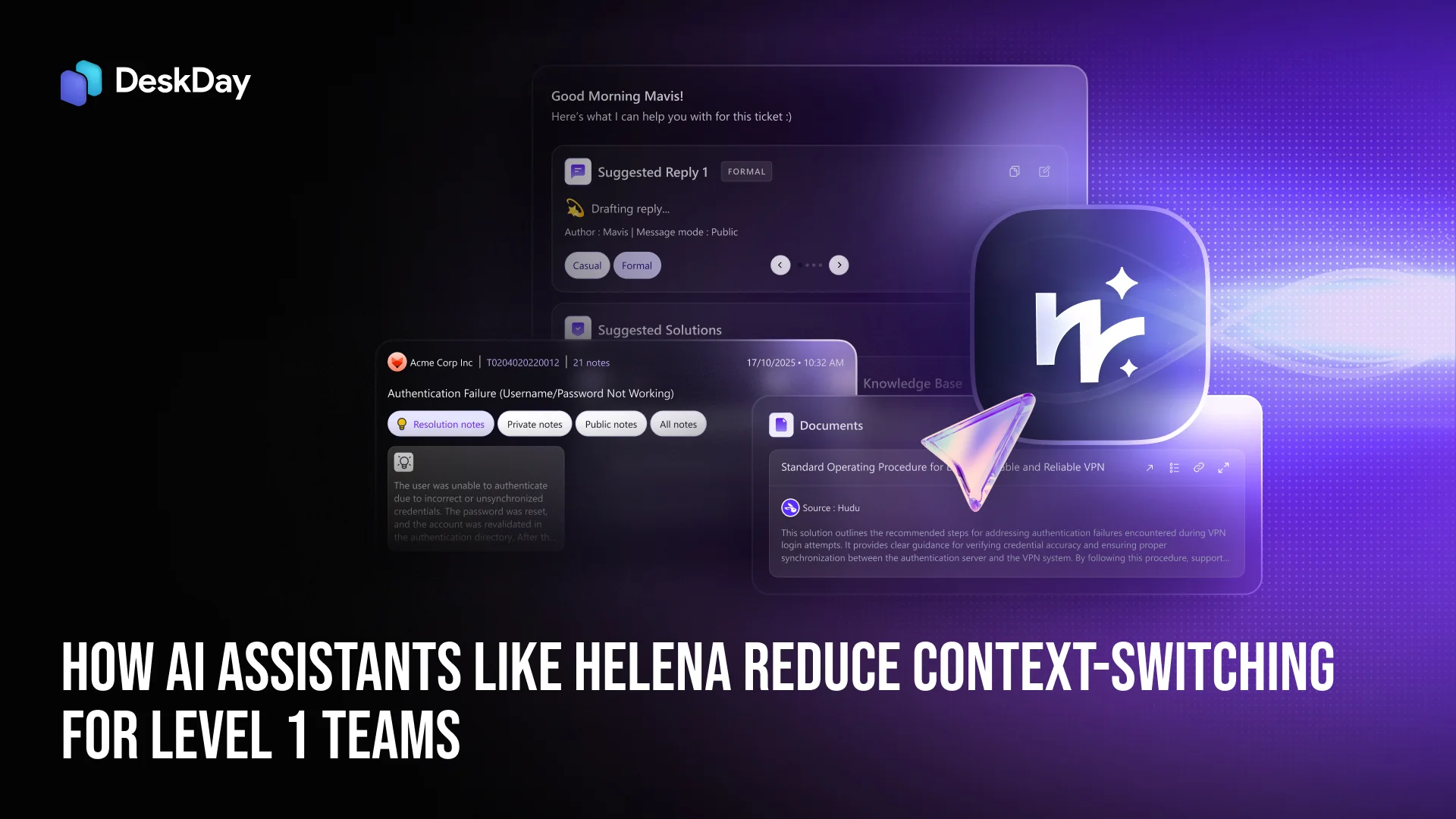
Helena is DeskDay’s AI service desk assistant designed to sit inside the L1 workflow, not beside it.
The idea is simple: instead of forcing techs to go out and gather context, Helena brings the context in. And when Helena is wired into your Hudu documentation and past ticket history, that becomes very powerful for front-line teams.
Let’s look at how it reduces context-switching step by step.
Before a tech types a single word, Helena goes to work in the background.
For a new ticket, Helena can automatically assemble:
Instead of the tech bouncing between DeskDay, Hudu, and old tickets, Helena surfaces a concise “pre-flight briefing” right in the ticket.
No extra tabs. No fishing around for the right keyword. Just context where the L1 tech already is.
This lines up with wider industry findings: MSPs that invest in proper service desk systems see reductions in time spent searching for information and noticeable gains in productivity and support performance.
Helena is basically operationalizing that for the service desk tier that needs it most.
Once the tech understands the situation, the next time sink is writing the response.
Helena’s Smart Reply Suggestions handle that in a way that still keeps the human in charge:
As the chat continues, Helena keeps updating suggestions based on new messages.
The tech is no longer typing from scratch or hunting for the right macro. They’re reviewing and editing. That’s a big mental shift.
Generative AI in help desks has already been shown to significantly reduce ticket volume and manual effort when used for automation and virtual assistance. Helena applies that same principle, but anchored in your own tickets and documentation.
This is where the Hudu integration earns its keep.
When Helena is connected to Hudu, she can:
For the L1 tech, it feels like this:
No separate Hudu tab. No “where did we document that again?” Just Hudu intelligence injected directly into the ticket.
Over time, as you standardize more SOPs into Hudu, Helena becomes sharper, especially for L1 issues that repeat frequently.
A lot of the real magic in an MSP never makes it into formal documentation:
These often live in old tickets, chat threads, or informal notes.
Helena can mine this “unstructured” history:
For L1, this means something powerful:
“We’ve seen this combination of error + device + site 7 times. Last time, it was resolved by applying fix XYZ from ticket #1234. Here are the steps we followed.”
Over time, you can formalize these high-value fixes into Hudu. Until then, Helena acts as the bridge between raw tribal knowledge and standardized SOPs.
L1 techs aren’t just dealing with technical issues; they’re dealing with people who are often stressed, blocked from doing their jobs, or escalating to leadership.
Helena’s sentiment insights help here:
This gives L1 techs quick visual cues:
You’re not asking your techs to open another dashboard to see this. Helena brings it into the ticket view as a timeline that updates each time Helena is called, so techs can see how the mood has shifted across the conversation.
Again, less context-switching. More focused, appropriate responses.
Helena doesn’t take control away from the L1 tech.
This is important for trust. L1 teams learn that Helena is there to do the heavy lifting on search, drafting, and recall, but they are still the ones responsible for the fix.
Done well, AI assistance should feel like a seasoned colleague whispering in your ear, not a robot grabbing the keyboard.
Let’s make this concrete.
Sarah, an L1 tech, starts her shift:
By the end of the day, she’s handled maybe 18 tickets, feels drained, and has added one new line to a Hudu doc “to fix it later.”
Same Sarah, same queue. But now:
Sarah spends her time on actual diagnosis and communication, not on looking for where the knowledge lives. She closes more tickets with less stress, and the quality of the knowledge footprint improves with every resolved case.
If you implement Helena AI with Hudu plugged in, you should expect to see movement in a few specific metrics over time:
Research around knowledge systems and AI assistants shows clear benefits: reduced search time, faster resolutions, better employee performance, and higher satisfaction for both staff and end users.
Helena is simply bringing those benefits right into the L1 frontline, where seconds and context matter most.
Context-switching has quietly become one of the biggest hidden costs in modern service desks, especially for Level 1 teams. Documentation alone can’t solve it. More tools can’t solve it.
What does move the needle is:
That’s the promise of Helena AI working side by side with Hudu.
If you want your L1 team to stop living in five tools at once and start working from a single, intelligent console, this is the direction to go: connect your documentation, connect your ticket history, and let an AI assistant do the context-gathering so your people can do the problem-solving.

Get exclusive content on the MSP industry and become a part of the DeskDay community.


