For most MSPs, the question is no longer whether AI can draft ticket replies, but whether technicians will trust those replies enough to put their name on them. Trust is now the real bottleneck between AI pilots and meaningful, scaled adoption in the service desk.
AI in MSP service desks has matured quickly: automated routing, sentiment analysis, suggested resolutions, and self-service have all moved from “emerging” to “expected” capabilities. Yet many service leaders see a familiar pattern: AI is switched on, vendors report impressive stats, but techs quietly ignore or override AI-drafted replies.
Why does that gap exist?
Techs don’t see the reasoning. Black-box suggestions that “look right” but don’t show which tickets, KBs, or logs they used feel risky, especially with demanding clients.
Generic tone + local nuance. MSPs live and die by nuances: which client is particularly sensitive to downtime, what has already been promised on an account, or how a specific contact prefers to be communicated with. AI that misses that nuance sounds like a canned chatbot.
Fear of silent automation. Many AI tools are designed to “reduce human touch,” which is exactly what terrifies technicians who own the outcome. If AI can act without them knowing, they become the ones blamed when something goes wrong.
Weak process and documentation under the hood. AI amplifies whatever it’s given. In MSPs with inconsistent documentation, incomplete KBs, and noisy ticket data, AI ends up re-surfacing those flaws at scale.
The result: AI promises “faster replies,” but the floor reality is a room full of techs hitting Delete on suggestions they don’t fully trust.
What “trust” really means for MSP techs
For a senior engineer, trusting an AI-written reply does not mean believing the model is “smart.” It means four very specific things in the context of MSP work:
It reflects everything they’d check anyway. A trustworthy AI reply factors in ticket history, affected assets, user role, SLA, previous incidents, and any linked projects or changes before drafting a response. If a human checks RMM alerts, contracts, or past notes, AI should too.
It is grounded in MSP-specific knowledge, not generic IT answers. Answers must reflect the MSP’s own standards, environment templates, and historical fixes, not a generic best practice pulled from a large model.
It leaves humans in control of what the client sees. Human-in-the-loop is not a marketing phrase here; it’s the fundamental safety system. AI should propose, never unilaterally commit.
It saves time without increasing mental load. If techs spend more time second-guessing AI than writing the reply themselves, trust declines and adoption stalls. The bar is not perfection, it’s: “Is this a faster, safer starting point than a blank screen?”
For MSP leaders, designing AI around these realities is the difference between “AI as a slide in the QBR” and “AI as a genuine force multiplier.”
Why MSPs need AI-written replies at all
It’s tempting to say, “If trust is so fragile, why not just keep humans writing everything?” But MSP economics and client expectations are making that impossible.
Key pressures:
Rising ticket volume, flat headcount. Remote/hybrid work, SaaS sprawl, and constant change have driven ticket load up while labor markets stay tight. AI-assisted replies are one of the few levers left that can scale output without immediate hiring.
Response-time expectations collapsing. End users judge MSPs against the consumer apps they use daily. Waiting hours for a simple acknowledgement now feels unacceptable, especially for high-value clients.
Variability in quality between techs. The gap between a seasoned senior engineer and a new L1 is wide. AI-drafted replies, when trained on your own best practice, can raise the floor of consistency across the team.
Margin pressure and competitive differentiation. MSPs that can show demonstrable improvements in response times, CSAT, and documentation completeness using AI will outcompete those that still rely only on linear headcount growth.
So the question is not whether AI should be involved in ticket replies. It’s whether it can be done in a way that protects the technician’s judgment and client trust.
From auto-replies to “copilot replies.”
Most AI deployments in the service desk fall into one of two patterns:
Automation-first (bot replaces tech): Tools that try to fully automate responses for entire classes of tickets: password resets, common “how-to” questions, VPN issues, often work in theory but create edge-case landmines in practice. When something falls outside the script, clients get wrong or incomplete answers, and techs must pick up the pieces.
Copilot-first (AI drafts, human decides): Tools that focus on drafting strong first replies, surfacing relevant context, and generating follow-ups, but always require a human to approve, tend to see higher adoption and less resistance.
For ticket replies, “copilot-first” is emerging as the sustainable model for MSPs because it directly matches how techs want to work: AI handles the reading, summarizing, and drafting; humans handle judgment, edge cases, and relationships.
The prerequisites MSPs overlook
Many AI initiatives fail not because the AI is weak, but because the environment isn’t ready. Before expecting techs to trust AI-written replies, MSPs need to address several foundations:
Ticket hygiene and categorization. Dirty data in tickets: missing categories, inconsistent priorities, vague descriptions, leads to noisy suggestions. AI can’t infer what humans never recorded.
KB maturity. AI systems rely heavily on knowledge bases and previous resolutions. If your KB is incomplete, outdated, or stored across multiple silos, AI will be pulling from an unstable foundation.
Clear policies on where AI is allowed. MSP leaders must define which ticket types AI can draft replies for, which require human-only handling, and what “good” looks like in each scenario.
Change management and communication. Without clear messaging, techs assume AI is a threat to their role. The message needs to be explicit: AI drafts, humans decide; AI speeds you up, but it does not replace your expertise.
When those basics are in place, AI becomes a trusted colleague instead of an unpredictable intern.
Where many tools start from “What can we automate?”, Helena starts from “What does a tech need to see to trust the next move?”
Unified ticket context: no more blind replies
Techs don’t trust AI replies when they can’t see the full picture themselves. Helena tackles that by pre-arranging context before a tech even starts typing.
For every ticket, Helena brings together:
Device and user context from DeskDay’s PSA and integrated tools.
Similar closed tickets and how they were resolved.
Linked KB articles and internal documentation.
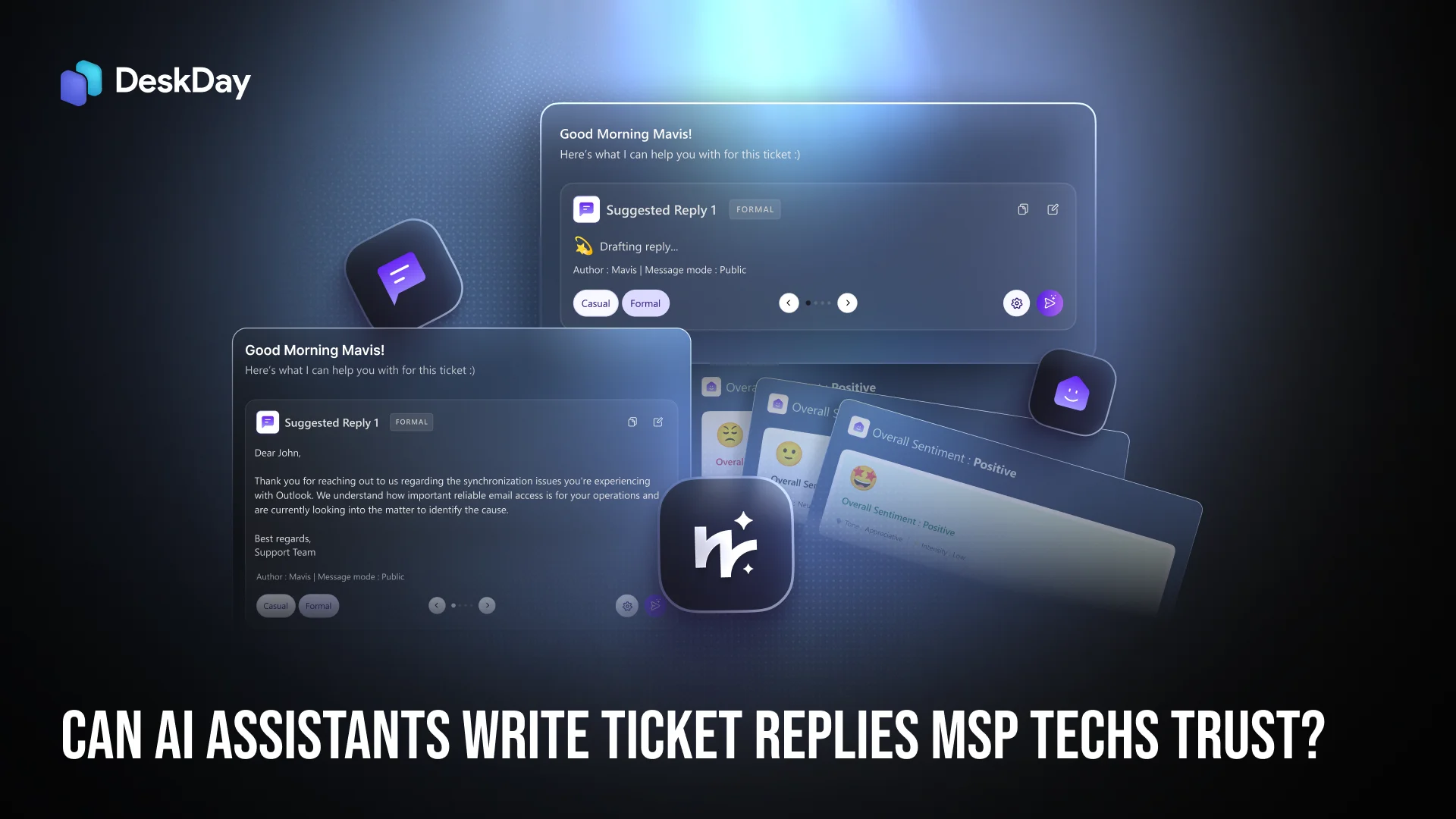
Sentiment analysis of the user’s current and past communications.
Instead of having to hunt across multiple tabs, techs see a single, rich view anchored right where they work. The AI-drafted reply is not an isolated guess; it is visibly tied to the same inputs a good technician would check manually.
Smart reply suggestions: starting from something, not nothing
Helena’s Smart Reply Suggestions feature is intentionally constrained and opinionated.
When a new ticket arrives, Helena:
Reads the full ticket and recent history.
Checks similar tickets and proven resolutions from your own PSA data.
Pulls relevant KB snippets into the background.
Drafts a clear, context-aware reply that techs can send as-is or edit.
As the conversation continues, Helena refreshes its suggestions based on new messages and evolving sentiment. The tech never has to start from a blank screen; their work shifts from “authoring from scratch” to “reviewing and adjusting,” which is far faster and safer.
Human-in-the-loop by design, not as a disclaimer
Helena’s architecture enforces human approval as a hard boundary:
No reply is sent without a technician explicitly approving it.
No ticket is updated or closed automatically behind the scenes.
AI is clearly framed as assistance, not autonomy.
This matters culturally and operationally. Techs know Helena cannot “go rogue” with clients under their name, which makes them far more willing to lean on AI suggestions.
Grounded in your MSP’s own knowledge
Rather than relying purely on a generic model, Helena grounds its suggestions in your existing ticket data and documentation.
Helena:
Syncs automatically with your KB, so new articles and updates are immediately available to its reasoning.
Surfaces similar closed tickets from your environment, not from some abstract corpus.
Learns from repeated resolutions and patterns over time, letting your real-world best practices shape future replies.
In other words, Helena writes the way your MSP solves problems, not the way a generic chatbot imagines an MSP should respond.
Sentiment-aware responses: matching tone to the moment
Trust in AI replies is not just about technical accuracy; it is also about emotional intelligence.
Helena performs advanced sentiment analysis on ticket messages and adjusts both:
The tone of suggested replies (more empathetic for frustrated users, more concise for neutral operational updates).
What it surfaces to the tech (e.g., highlighting past escalations or complaints for that contact).
For a stressed L1, having Helena propose a calm, empathetic response to an angry email reduces cognitive load and the chance of escalation.
Day-one impact, not just future promise
Because Helena works on top of the data MSPs already have in DeskDay, its impact is visible quickly:
3x faster response times by reducing the time techs spend reading and drafting.
Up to 10 hours saved per tech per week by eliminating repetitive documentation hunting and reply authoring.
Higher CSAT scores, driven by faster, sentiment-aware responses.
100% human control preserved over what is sent, changed, or closed.
Those metrics show a key point: trust and productivity do not have to be in tension if AI is framed as augmentation, not replacement.
Where MSPs should and shouldn’t use AI-written replies
For MSP leaders designing an adoption roadmap, the goal is to pick use cases where AI-written replies create clear value with minimal risk.
High-fit scenarios:
Low-risk, high-volume tickets. Password resets, MFA prompts, VPN instructions, printer issues, license questions; assistants can draft responses that techs verify and send in seconds.
Status updates and SLA-sensitive acknowledgements. “We’ve received your ticket.” “Here’s where we are,” “We’re waiting on vendor X”; all benefit from speed, consistency, and tone control.
Documentation-intensive issues. When a ticket involves well-documented steps, assistants can synthesize the relevant KB content into a concise, human-ready reply that techs simply fine-tune.
Sentiment-critical interactions. For clients with a history of frustration or escalation, assistants’ sentiment-aware suggestions help techs respond in ways that de-escalate instead of inflame.
Lower-fit or “human-first” scenarios:
Complex, multi-stakeholder incidents. Major outages, security incidents, and contractual disputes often require careful negotiation and context that go beyond what even a rich dataset can reflect.
Situations involving legal, compliance, or HR risk. Anything that touches legal interpretation, regulatory obligations, or internal HR matters should remain human-led, with AI, at most, helping with structure, not substance.
A simple rule of thumb for rollout: if you’d be comfortable letting an experienced L1 draft the reply and have an L2 review it, you can usually let AI assistants like Helena draft and have your tech review it.
How to earn technician buy-in
Even the best-designed AI assistant fails if techs feel it’s being imposed on them instead of being built for them. MSPs that succeed in deploying AI-written replies tend to take a few deliberate steps:
Involve frontline techs in pilot design. Let them decide which ticket types assistants like Helena should touch first and what “good” looks like in a suggestion.
Make the “human in control” boundary explicit. Communicate, repeatedly, that AI cannot send communications on their behalf without consent, and show the control points in the UI.
Start with optional, then default-on. Early on, let techs opt in per ticket. Once trust grows and data supports it, flip the default so suggestions are present on most tickets, but still always editable.
Share tangible wins. Track and show metrics such as time saved per reply, CSAT improvements, and reduced after-hours burnout as Helena adoption grows.
When techs see AI cutting their cognitive overhead instead of questioning their competence, trust follows naturally.
The future: from trusted replies to trusted workflows
Ticket replies are just the first visible surface area where MSPs and technicians test their trust in AI. As that trust is earned, the conversation expands:
If Helena can reliably draft replies, can it also propose next-step actions in RMM or workflows in your PSA?
If Helena can learn from closed tickets, can it start predicting which tickets are likely to escalate and propose preemptive outreach?
If Helena can match tone to sentiment, can it guide dispatching and escalation based on client health and risk?
The organizations that win will not be those who simply “turn on AI,” but those who treat technician trust as a product requirement, and design assistants like Helena to respect, amplify, and scale human judgment instead of trying to bypass it.
For MSPs asking whether AI assistants can write ticket replies techs trust, the answer is yes, but only when trust is engineered into the assistant’s design, the PSA foundation, and the rollout strategy from the very beginning. Helena is built precisely for that world.
FAQs: AI Assistants for MSP Ticket Replies
Can AI assistants really write ticket replies MSP techs can trust?
AI assistants can draft accurate, well-structured replies when they’re trained on past tickets, knowledge bases, and MSP workflows. Trust improves when techs review, edit, and approve responses instead of sending them blindly.
Do AI-generated ticket replies replace MSP technicians?
No. AI assists technicians by handling drafts, summaries, and repetitive responses. Final judgment, troubleshooting, and customer communication still rely on human expertise.
How do AI assistants improve response time in MSP service desks?
AI reduces time spent typing, searching for past fixes, and summarizing issues. By surfacing relevant context instantly, techs respond faster without sacrificing accuracy or tone.
Are AI ticket replies accurate enough for real customer communication?
Accuracy depends on data quality and oversight. When AI pulls from approved knowledge bases and previous resolutions, replies are consistent and reliable, especially with technician validation.
What’s the biggest risk of using AI for ticket replies in MSPs?
The risk isn’t AI itself, but over-automation. Sending replies without review can hurt trust. Successful MSPs use AI as support, not autopilot, keeping humans in control.
Join our digest
Get exclusive content on the MSP industry and become a part of the DeskDay community.

 Team DeskDay Team DeskDay


