
 Team DeskDay Team DeskDay
Professional Services Automation (PSA) has been the backbone of managed service providers (MSPs) for over two decades. What began as software to track time, manage projects, and generate invoices has grown into the nerve center of MSP operations. Yet the world MSPs serve has changed dramatically. Customers no longer tolerate slow, siloed communication. Techs are bombarded by alerts and platforms. And with AI, automation, and omnichannel support reshaping expectations, PSA must evolve once again.
The future isn’t about replacing PSA with something entirely new. It’s about transforming PSA into a conversational, omnichannel, AI-augmented ecosystem that reflects how people actually work and communicate today.
PSA emerged in the late 1990s as a breakthrough for IT service organizations. Before PSA, MSPs juggled spreadsheets, emails, and separate accounting tools just to keep track of billable hours and projects. Early PSA systems consolidated these functions: time tracking, resource planning, billing, and reporting, into one platform.
By the 2000s, PSA platforms matured into comprehensive solutions. Leading vendors added CRM modules, ticketing, contract management, and resource scheduling. For a time, PSA felt like the “single pane of glass” MSPs had always wanted.
But cracks began to show. As MSPs scaled, traditional PSA platforms became burdened with:
The result? Many MSPs only use 10–20% of their PSA’s features, relying on integrations or workarounds to fill the gaps. Instead of simplifying operations, PSA often became yet another system to manage.
Fast forward to the present. MSPs aren’t just providing IT support anymore; they’re customer success partners, cybersecurity guardians, and cloud transformation guides. And they’re doing all this while navigating turbulent market conditions.
Here’s what defines the pressure today:
Traditional PSA wasn’t built for this. A ticketing system that only logs and tracks isn’t enough. MSPs need PSA that converses, collaborates, and coordinates in real time.
The answer isn’t a shiny new acronym. It’s PSA, reimagined. Conversational PSA takes the foundation of PSA: projects, billing, contracts, SLAs, and embeds it inside natural, omnichannel workflows.
That means:
Conversations, whether chat, voice, or email, aren’t scattered across tools. They live inside the PSA, where they belong.
When PSA goes conversational, the impact cuts across every layer of the MSP:
Insights into not just “what got resolved,” but how it was resolved and how it can be improved.
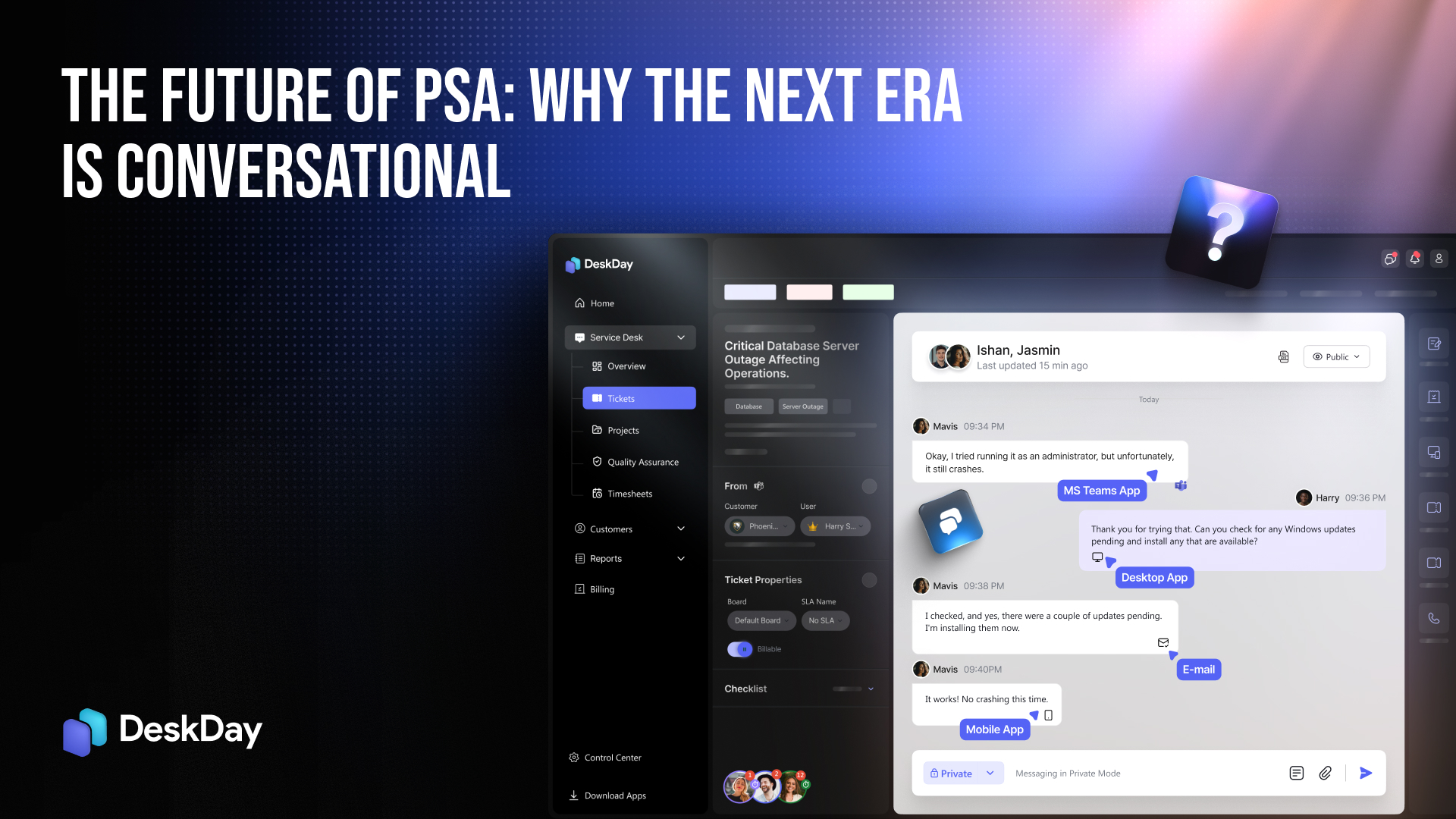
Omnichannel ticketing: An end-user creates a ticket via Teams about a login issue. The PSA creates a ticket instantly, logs the ticket description, and allows the tech to reply in the same thread, while also tracking SLA times.
AI-powered triage: Tickets are automatically categorized by urgency and sentiment. Angry messages get flagged for immediate response, while routine requests are queued appropriately.
Integrated knowledge base: The PSA suggests articles mid-chat, reducing resolution time and empowering end-users to self-serve when appropriate.
Proactive reporting: MSP leaders see dashboards showing not just closed tickets, but trends in communication channels, recurring pain points, and tech workload balance.
The true promise of conversational PSA is that it lets MSPs shift focus. Instead of wrestling with integrations, chasing updates, or managing a jungle of apps, they can zero in on problem management, which matters most to the customer.
This shift ensures:
The future is not about PSA versus Conversational PSA. It’s about PSA’s rebirth into something more natural, more human, and more adaptable.
The MSP industry has always thrived on adaptation. From the early days of managing servers onsite to today’s hybrid, cloud-first operations, the constant has been change. PSA must evolve the same way.
By embracing conversational models, where service delivery happens in the language of users and techs alike, PSA becomes more than a record-keeping system. It becomes the living, breathing hub of the MSP.The era of conversational PSA is here. It’s not a buzzword. It’s the path to smarter service, stronger relationships, and a more sustainable business for MSPs ready to meet the future head-on.
Conversational PSA embeds all PSA functions—ticketing, SLAs, contracts, billing—into natural, chat-driven workflows. Users (customers, techs) interact via chat (Teams, email, web, mobile), not siloed screens or forms.
Traditional PSA tools focus heavily on separate modules (ticketing, billing, project management) and often force switching among dashboards and integrations. Conversational PSA keeps everything in one flow—no constant context switching. It also uses AI and omnichannel communication to reduce friction.
Some of the key benefits include:
1. Faster resolution (because techs and customers converse in one place)
2. Less overhead from tool sprawl and integrations
3. AI assistance to triage/respond/suggest knowledge during conversations
4. Improved visibility (reports not only on what’s done, but how and how it was communicated)
5. Better customer satisfaction through consistent, multichannel support.
Yes, if the PSA supports integrations with your tools (RMM, accounting, knowledge base, etc.). DeskDay’s model is to embed conversational workflows into the stack, not force everything to change. The idea is to reduce complexity, not add more.
1. Some learning curve: Although conversational PSA is designed to simplify, changing how people work (from dashboards/forms to chat) takes adjustment.
2. Integration gaps: As newer platforms evolve, there may be edge integrations that aren’t yet built.
3. Custom workflows: Very bespoke or complex workflows might need extra setup or customization.
4. Change management: Ensuring techs and customers adopt the conversational mindset (responding via chat, maintaining clarity in conversations) is key.

Get exclusive content on the MSP industry and become a part of the DeskDay community.


