 Team DeskDay Team DeskDay
For many MSPs and IT Teams, tech productivity has long been held hostage by one quiet, costly problem: context hunting. Techs don’t lose time fixing issues; they lose it searching for the right documentation to start fixing them.
A ticket arrives, and the cycle begins: switch to the PSA, check past ticket notes, open the documentation portal, maybe cross-reference an internal KB. Each small pause feels trivial: five minutes here, three minutes there, but across a full day, that trickle becomes a flood of hours lost to searching instead of solving.
It’s not inefficiency by incompetence. It’s inefficiency by design; a byproduct of how service desk systems were built: reactive, fragmented, and human-dependent in all the wrong ways.
Ask any seasoned helpdesk tech what the hardest part of their job is, and you won’t hear “complex tickets.” You’ll hear, “finding what I need fast enough.” Service desks today are built on layers of SaaS tools and documentation systems that rarely communicate cleanly with each other.
That disconnect creates a cognitive load that saps attention and erodes rhythm. The more tools in use, the more context shifts a tech makes per ticket. And in the world of client support, flow is everything. Lose it once, you lose minutes; lose it ten times, you lose momentum, and customer satisfaction inevitably follows.
MSPs operate in constant pressure mode: improving SLAs, dealing with talent shortages, and maintaining margins. Every minute reclaimed from administrative drag directly adds strategic value. Yet no incremental process tweak or new productivity metric has truly solved the root issue: the fragmentation within the service desk.
That’s why the rise of AI in the MSP world has begun shifting from hype to tangible productivity. And among those innovations stands Helena, a real-world application of AI built not to replace techs, but to return their time.
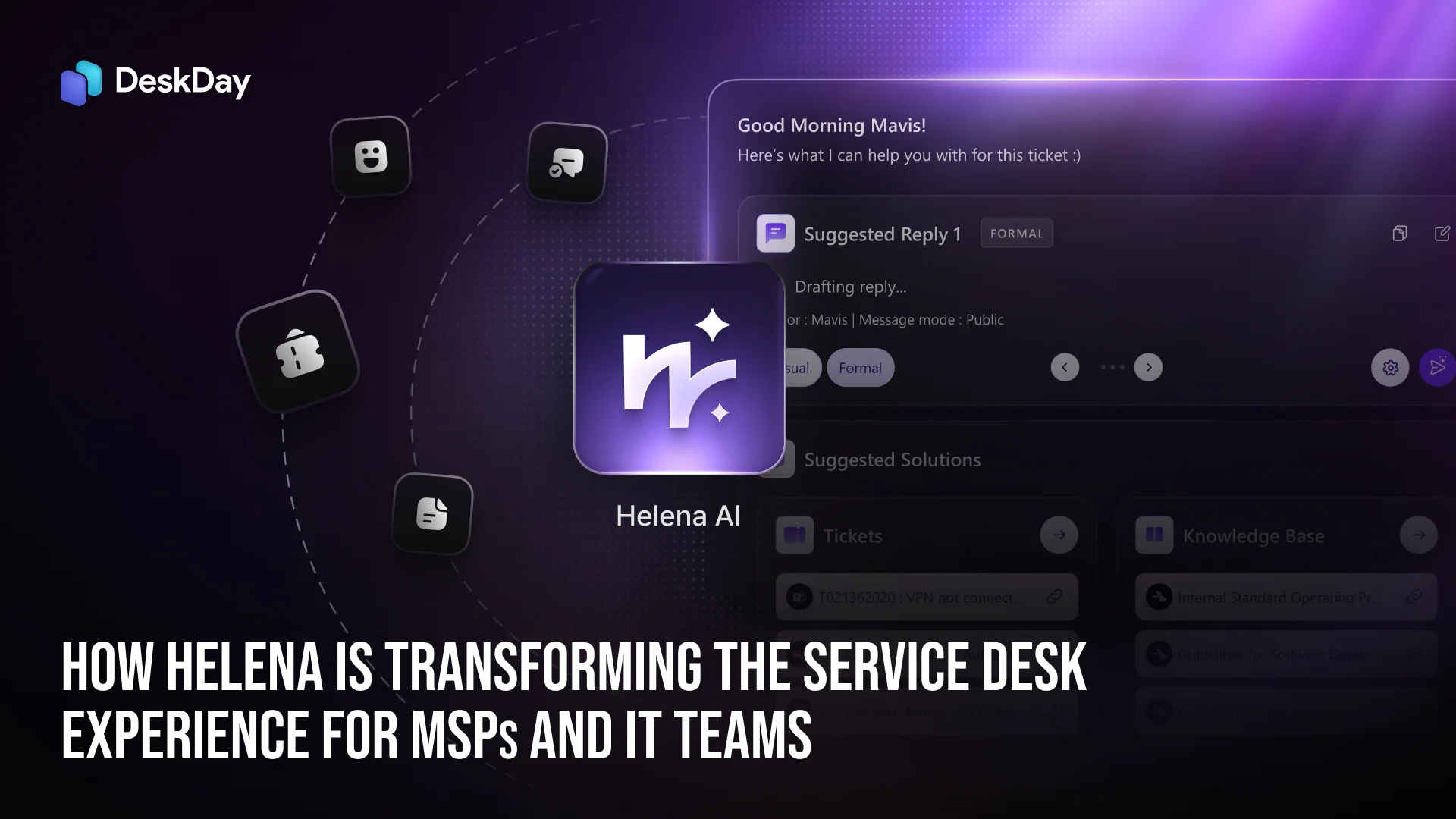
Helena is DeskDay’s AI service desk assistant, designed specifically for MSP and IT teams. It doesn’t reinvent the workflow; it re-energizes it. Instead of forcing techs to piece together data from multiple places, Helena surfaces everything relevant: ticket history, sentiment trends, related KBs, and even similar past tickets directly inside the ticket view.
It’s a subtle but profound difference. Rather than AI as a distant feature, Helena becomes an embedded partner, shaping how technicians think, read, and act.
In practice, this means fewer clicks, faster context, and more consistent communication. Over time, this efficiency compounds, faster response times, fewer escalations, and, just as importantly, lower cognitive fatigue.
Here’s how it delivers precision and pace without sacrificing control:
Automated Suggested Replies: Helena drafts context-aware responses instantly, adapting tone and content dynamically as conversations progress. Techs need to simply verify and personalize.
Auto Knowledge Base Sync: At ticket creation, Helena instantly surfaces the most relevant knowledge article from internal or connected documentation tools, such as Hudu, eliminating time-consuming searches.
Similar Ticket Sync: Drawing from past resolutions, Helena identifies proven fixes to similar issues, turning experience into reusable, repeatable intelligence.
Advanced Sentiment Analysis: By reading tone and emotion in real time, Helena alerts teams to rising frustration or urgency, enabling proactive recovery before an escalation.
Unified Ticket Context: Every piece of insight: replies, documentation, sentiment, history, appears in a single interface, so technicians never waste time switching tabs or retracing steps.
The appeal of Helena isn’t that it automates away the role of the tech, but that it amplifies their judgment. Its suggested replies, sentiment analysis, and knowledge syncing aren’t commands; they’re cues. Helena drafts, recommends, and surfaces intelligence, while the tech stays firmly in control.
This “human-in-the-loop” model reflects how real service work unfolds: nuanced, contextual, and deeply human. The best AI for MSPs, then, isn’t the one that replaces expertise, but the one that helps it shine through faster and more clearly.
Helena’s rise signals a bigger industry shift; the move from automation for efficiency to AI for enablement. MSPs are beginning to measure success not just in ticket closure speed, but in tech well-being, customer empathy, and operational flow.
When AI clears the clutter, techs can focus on what truly drives value: the creative problem-solving and human reassurance that no machine can replicate. It’s a small philosophical shift, but one that redefines the economics of service delivery.
Of course, AI in an MSP environment raises valid questions about privacy and control. Helena’s design acknowledges that reality, operating within a secure hybrid AI ecosystem built by DeskDay that prioritizes data sovereignty and transparency. No customer data is ever used for external training, and MSPs retain full control over activation and scope.
For any AI to earn a place in the tech’s daily workflow, it must first earn trust. Helena is built on that foundation.
As AI becomes central to operations, the competitive edge won’t belong to the MSPs that simply adopt new tools, but to those that use AI to empower techs, not overwhelm them.
Helena represents that future: a service desk where intelligence delivers speed, and empathy remains intact. It’s a service that’s not just faster, but smarter, steadier, and more human.Because the best service desks of tomorrow won’t just resolve tickets faster.
They’ll give time back to techns, back to teams, and back to the work that really matters.

Get exclusive content on the MSP industry and become a part of the DeskDay community.