
Datto RMM + DeskDay is live now! If you're a Datto RMM user, sign up today to claim your free trial Get Started

 Team DeskDay Team DeskDay
In every Managed Service Provider operation, knowledge is currency. It determines how fast tickets close, how consistently service is delivered, and whether an MSP can grow without burning out its best people.
Yet most MSPs still treat documentation as an afterthought. Something written when there’s time. Something stored wherever it fits. Something everyone agrees is important, but no one owns with discipline.
The result is familiar: knowledge scattered across personal notebooks, Slack threads, aging wikis, and the heads of senior engineers who quietly carry the firm on their shoulders.
That fragmentation doesn’t just slow things down. It reshapes how an MSP operates under pressure, and rarely in its favor, draining profit, utilization, and service quality.
Most documentation problems don’t show up on a P&L. They surface as small inefficiencies, repeated daily, until they harden into operational drag.
When techs spend 20–30% of their day hunting for SOPs, scripts, or client-specific details, that time isn’t just unproductive. It’s unbillable. It stretches resolution timelines, inflates ticket aging, and quietly lowers effective utilization.
Over a month, that “just a few minutes per ticket” becomes days of lost capacity; capacity that MSPs often try to recover by hiring earlier than necessary.
Switching between a PSA, documentation portal, RMM tool, and ticket notes isn’t just annoying. It fractures cognitive flow. Each interruption resets attention, increases error rates, and lengthens decision time.
In high-volume environments, this adds measurable drag to MTTR and first-response time. The system, not the tech, becomes the bottleneck.
When documentation lives across Confluence, Notion, SharePoint, and personal files, knowledge stops being institutional. It becomes tribal.
There’s no shared taxonomy. No guarantee of freshness. No confidence that the “right” document is the one being followed. And when someone leaves, critical understanding leaves with them.
That’s not just an HR risk. It’s an operational one.
Poor documentation pushes work upward. Level 1 techs escalate not because issues are complex, but because context is missing. Senior engineers become interruption hubs. Onboarding stretches longer than it should.
The MSP pays twice: once in senior time and again in slower SLA adherence.
Leading MSPs are starting to see documentation differently.
Not as static reference material, but as operational infrastructure.
The next evolution isn’t better wikis or prettier editors. It’s knowledge that lives where work happens, shaped by real ticket data and available at the exact moment decisions are made.
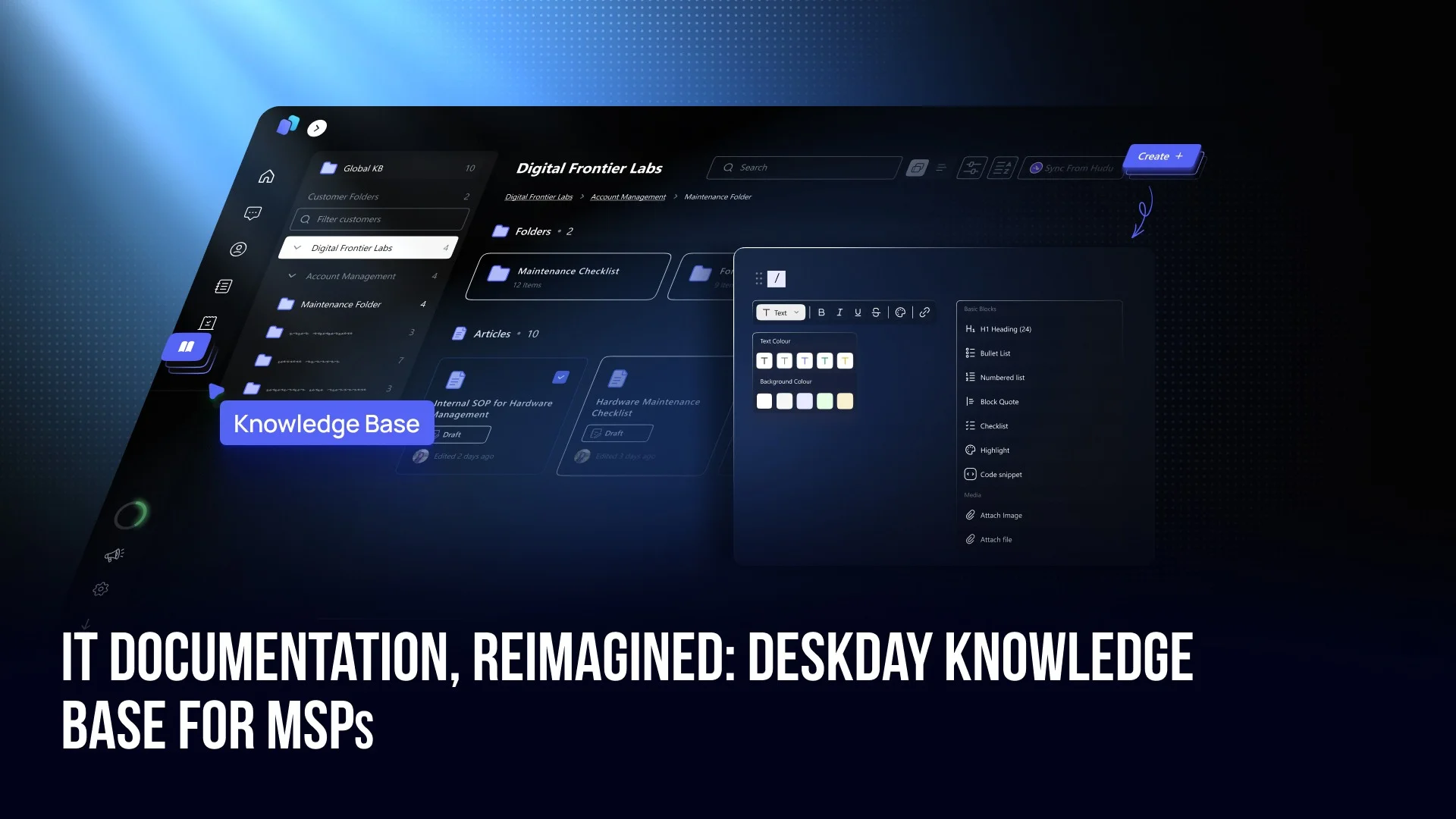
This is the thinking behind DeskDay’s Internal Knowledge Base.
DeskDay’s Internal Knowledge Base isn’t positioned as a standalone documentation product. It’s designed as a native layer inside the PSA itself.
That distinction matters.
When knowledge is embedded directly into the service desk environment, it stops being something techs have to remember to check. It becomes part of the workflow; quietly present, context-aware, and immediately useful.
Most MSPs already think in scopes: global standards versus client-specific nuance. Documentation should follow the same logic.
With DeskDay’s Internal KB, teams can:
Documentation finally aligns with how MSPs segment and serve clients in the real world.
The most valuable documentation is the one a tech sees while working, not after pausing to search.
DeskDay allows KB articles to be linked directly inside active tickets. Relevant content appears alongside ticket context, not in a separate tab or tool.
This eliminates swivel-chair behavior. No copy-pasting. No context loss. Knowledge becomes part of the action, not an interruption to it.
Documentation often fails because it’s written like a manual, not a runbook.
The Internal KB supports:
The goal isn’t prettier documentation. It’s documentation that techs actually follow.
Auto-save and real-time editing sound mundane, but they change behavior. When techs trust that their work won’t disappear, they document more willingly.
Long-form SOPs, step-by-step runbooks, and evolving guides become easier to maintain because friction is removed.
Documentation changes over time. Without visibility, those changes can introduce risk.
DeskDay’s version history ensures:
Knowledge evolves without becoming unstable.
DeskDay’s AI service desk assistant, Helena, doesn’t rely on manual searches. It reads the ticket itself: issue type, device, keywords, historical patterns, and surfaces the most relevant KB articles automatically.
For techs, this changes the experience entirely. The solution appears before the question is even asked.
The impact is practical:
Most importantly, it levels the field. Junior techs gain access to senior-level insight without slowing the organization down.
Standalone documentation tools can be powerful, but they come with tradeoffs: separate licenses, sync headaches, and limited context awareness.
For small and mid-market MSPs, those tradeoffs often outweigh the benefits.
A natively integrated knowledge base removes friction. No setup gymnastics. No mental overhead. Just documentation that knows what ticket it’s serving.
The Internal KB simplifies how knowledge flows through your MSP:
This built-in workflow lets you mature your documentation library with agility, without breaking existing knowledge access during updates.
An internal knowledge base isn’t just about writing things down; it’s about operational intelligence.
With DeskDay’s KB:
Your documentation becomes a living operational asset, one that compounds in value every day.
The MSPs that scale best over the next decade won’t be the ones with the most tools or the biggest teams.
They’ll be the ones who treat knowledge as infrastructure.
DeskDay’s Internal Knowledge Base isn’t just a repository. It’s the system that keeps experience transferable, decisions consistent, and service resilient.
This is how modern MSPs grow, by making what they know work as hard as their people do.

Get exclusive content on the MSP industry and become a part of the DeskDay community.


