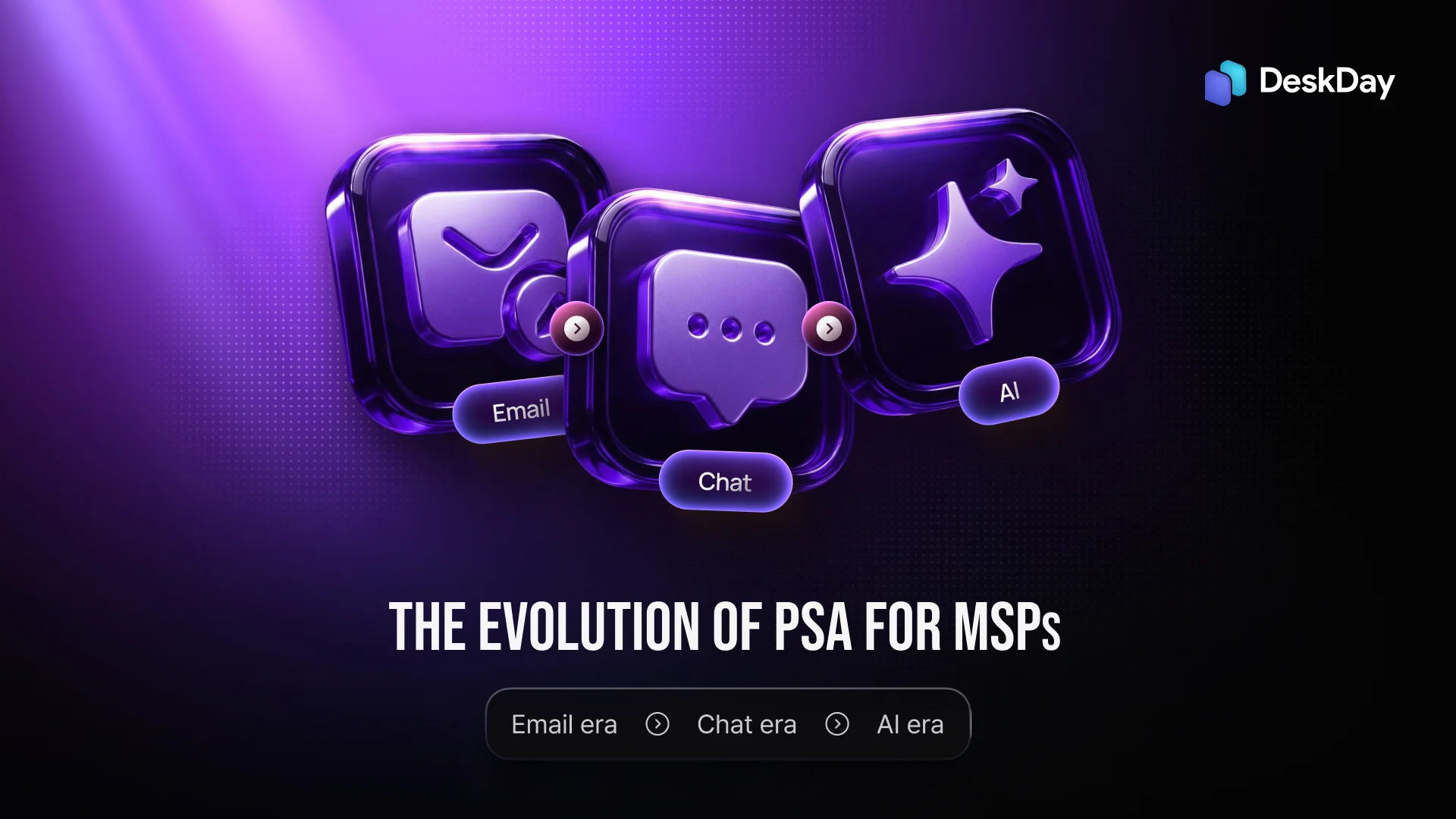
Managed Service Providers (MSPs) have always operated at the intersection of technology, service delivery, and profitability, where the tools they use to manage tickets, projects, time, and clients determine whether they thrive or merely survive. Professional Services Automation (PSA) software, once a simple time-tracking spreadsheet substitute, has evolved through three seismic eras: the Email Era of manual capture and reactive firefighting, the Chat Era of omnichannel unification and rule-based efficiency, and the nascent AI Era of predictive intelligence and agentic autonomy.
This evolution is not merely technological; it reflects MSPs’ maturation from MSP 1.0 break-fix shops scrambling for billable hours, to MSP 2.0 proactive monitors chasing utilization targets, to MSP 3.0 strategic advisors leveraging data-driven outcomes. Each era addressed the core bottlenecks of the prior one: manual drudgery, fragmented communication, and cognitive overload, but introduced new frontiers.
By 2026, with 87% of MSPs planning AI investments amid talent shortages and margin pressures, the AI era stands as an existential pivot: PSAs are no longer back-office tools but intelligent operating systems that redefine scalability, client retention, and competitive moats.
What follows is a comprehensive dissection of this progression, grounded in industry data, historical inflection points, and forward-looking implications. MSP leaders ignoring this trajectory risk commoditization; those mastering it will capture the $500B+ managed services market by 2027.
Email Era (1990s–Early 2010s): The Birth of Structure in a Sea of Chaos
The Email Era dawned as MSPs formalized the break-fix model amid the Y2K boom and early outsourcing wave. PSA software emerged from professional services firms (consulting, legal) in the 1990s, adapted for IT by pioneers like ConnectWise (1997) and Autotask (2001). At its core, it digitized what was previously Post-it notes, phone logs, and Excel: capturing client requests via email forwarding, tracking billable time, and generating invoices.
Key characteristics and limitations:
Email as the Universal Intake. Every client interaction funneled through Outlook or similar, manually forwarded to a shared inbox. Techs printed emails, scribbled notes, and retyped details into PSA for tickets, leading to 39% of engineer time lost to admin. No threading meant lost context; duplicates and lost tickets were rampant.
Time Tracking as the North Star. PSAs like early ConnectWise emphasized timers synced to emails, with manual categorization (e.g., “Network Issue”) and approval workflows. Billing relied on exported CSVs reconciled against contracts, yielding 20–30% under-billing from forgotten hours.
Reporting:Static and Backward-Looking. Dashboards showed utilization (target: 60–70%) and revenue per tech, but lacked real-time visibility. MSPs served 50–100 endpoints per engineer, scaling only via headcount.
Scalability ceiling. MSPs could serve 50–100 endpoints per tech, but growth meant hiring linearly; profitability suffered from under-billed hours and lost tickets.
MSPs in this era were often founder-led, with 5–20 techs handling regional clients. Service delivery was reactive: a client email triggered a truck roll or remote session via nascent tools like LogMeIn. Profitability hinged on volume, not efficiency; margins hovered at 15–25%, eroded by unbillables.
The 2008 recession and RMM rise (e.g., Kaseya, LabTech) exposed email’s limits: MSPs needed proactive monitoring, but PSAs couldn’t integrate or automate. This birthed the Chat Era.
Chat Era (Mid-2010s–Mid-2020s): Unification, Automation, and the MSP 2.0 Promise
Chat-based PSAs like DeskDay and cloud PSAs like SuperOps.ai (2019), Halo PSA (2012), and Thread (2020s) transformed MSPs into proactive operations. Omnichannel intake: email, Slack, Teams, SMS, portals, created structured tickets, while API integrations with RMM (NinjaOne, Datto) enabled fixed-fee models. MSPs hit MSP 2.0: monitoring alerts, auto-generated tickets, utilization climbed to 75–85%.
Core innovations and capabilities:
Omnichannel Convergence. Chats auto-threaded into tickets with metadata (sender, channel, priority). Real-time collaboration via chat cut email ping-pong; canned responses handled 20–30% L1 volume.
Rule-Based Automation. If-then rules routed by client/SLA/tag (e.g., “VIP → NOC Lead”). Auto-assignments, escalations, and macros slashed manual triage by 40%.
Advanced Project and Financials. Gantt charts for MDR projects; profitability dashboards blending time entries, expenses, and contracts. AI-lite features (e.g., auto-categorization) emerged late era.
Yet gaps persisted: 62% of MSPs still faced project visibility issues, and technicians spent hours on context-switching between channels and tools. Chat unified intake, but couldn’t anticipate issues or generate intelligence from data; tickets piled up amid SaaS sprawl and hybrid work. GenAI’s 2023–2025 explosion cracked this open.
AI Era (2025+): Agentic Autonomy, Predictive Intelligence, and MSP 3.0
2026 marks the AI inflection: PSAs evolve into “agentic” systems with LLMs, autonomous agents, and hyper-personalization. 87% of MSPs invest here, driven by engineer shortages (up 40% demand) and client demands for 99.99% uptime. Tools like DeskDay Helena, SuperOps Monica, and Thread Magic Agents predict, draft, remediate, and advise; pushing utilization to 90%+ and enabling outcome-based pricing.
Transformative capabilities layered on:
Predictive Intake and Triage. GenAI auto-categorizes (95% accuracy), summarizes histories, and flags sentiment/escalation risk. Alerts from RMM trigger preemptive tickets.
Copilot Workflows. Helena-style drafting: context-aware replies grounded in KB/tickets, editable by humans. Cuts response time 3–5x; sentiment tunes tone.
Autonomous Agents. End-to-end remediation (e.g., reset password via API, verify, close)—handles 50–70% L1/L2 autonomously, escalating with handoff notes.
Revenue and Outcomes Engine. AI forecasts churn (sentiment + utilization), optimizes pricing, auto-generates upsell reports. Projects become “AI-orchestrated” with dynamic resourcing.
Three forces propelled these shifts, accelerating in the AI era:
Talent and margin pressures. MSPs face engineer shortages and 20–30% margin erosion; each era automated more to scale without headcount.
Customer expectations. From email delays to instant chat responses to predictive uptime, clients now demand consumer-grade speed and proactivity.
Tech maturity. Email → APIs/cloud → LLMs/agents enabled deeper integrations, with GenAI (e.g., ChatGPT-powered chatbots) as the 2025 inflection point
Persistent Challenges Across Eras
No era eliminated core MSP pains:
Data silos. Even AI PSAs struggle if RMM, KB, and CRM data isn’t unified—leading to hallucinated suggestions.
Human-AI handoff. Chat automation hit limits on nuance; AI requires “human-in-loop” for trust in high-stakes replies.
ROI measurement. Gains in speed must translate to profitability; poor implementations yield “AI theater” without billable uplift.
Era Comparison
Email (1.0)
Chat (2.0)
AI (3.0)
Automation
None (manual forward)
Rules (30–40% L1)
Agents (50–70% end-to-end)
Intelligence
None
Basic categorization
Predictive/sentiment/genAI
Utilization
60–70%
75–85%
90%+
Endpoints/Tech
50–100
200–500
1,000+
Margins
15–25%
25–35%
40–50%
MSP 3.0: What AI PSA Enables Next
The AI era unlocks MSP 3.0: from services to outcomes.
Self-healing operations. Agents auto-remediate 60% of tickets, escalating only complex issues.
Revenue intelligence. AI forecasts churn via sentiment, optimizes pricing via utilization data, and auto-generates upsell playbooks.
Copilot workflows. Tools like Helena draft replies grounded in your KB/tickets, cutting response time 3x while preserving tech control.
MSPs adopting AI PSA early (e.g., DeskDay) report 40% ticket volume drops and 2x margins by 2027. Laggards risk commoditization as AI commoditizes L1/L2 delivery.
Roadmap for AI PSA Adoption
Audit foundations. Clean tickets, mature KB, unify RMM-PSA before AI.
Pilot low-risk AI. Start with summarization/replies on L1 tickets.
Measure outcomes. Track response time, CSAT, utilization, not just tickets closed.
Scale to agents. Move to autonomous remediation once trust is earned.
The AI era isn’t incremental; it’s existential. MSPs that treat PSA as an intelligent operating system will dominate; those clinging to chat-era tools will service yesterday’s clients
Join our digest
Get exclusive content on the MSP industry and become a part of the DeskDay community.

 Team DeskDay Team DeskDay