In 2025, the landscape of Professional Services Automation (PSA) tools for Managed Service Providers (MSPs) is undergoing a significant transformation. These platforms have evolved from basic ticketing and billing systems to comprehensive, AI-driven solutions that are integral to operational efficiency and strategic growth.
The global PSA software market is experiencing robust growth, projected to increase from $13.56 billion in 2025 to $22.14 billion by 2029, reflecting a compound annual growth rate (CAGR) of 13% . This surge is driven by the increasing demand for streamlined operations, enhanced profitability, and the need for real-time insights into project and resource management. Source: (Professional Services Automation Software Market Share 2025 – 2034)
A notable shift in 2025 is the preference for unified platforms over fragmented toolsets. MSPs are moving away from disparate systems for ticketing, time tracking, and billing, recognizing that such fragmentation leads to inefficiencies and increased operational costs. Integrated PSA solutions now offer seamless workflows, combining project management, CRM, billing, and analytics into a single interface . Source: (The Future of PSA Software: Trends to Watch in 2025 and Beyond)
Artificial Intelligence (AI) is at the forefront of this evolution. Modern PSA tools leverage AI to automate routine tasks, predict project outcomes, and optimize resource allocation. For instance, AI-driven timesheet automation is revolutionizing how MSPs track billable hours, reducing manual errors and ensuring accurate billing . Source: (Professional Services Automation Software Market Share 2025 – 2034)
The MSP industry itself is on an upward trajectory, with global managed services revenue expected to grow by approximately 13% year-over-year in 2025, reaching $595 billion. The Asia-Pacific region is anticipated to lead this growth with a 15% increase, highlighting the global expansion and increasing reliance on MSPs . Source: (MSP trends and predictions 2025 – executive summary – Canalys)
In this dynamic environment, selecting the right PSA tool is crucial for MSPs aiming to stay competitive. The ideal PSA solution should not only streamline operations but also provide strategic insights, enhance customer satisfaction, and support scalability.
In the following sections, we will delve into the top 10 PSA tools for MSPs in 2025, evaluating each based on functionality, integration capabilities, user feedback, and overall impact on business performance
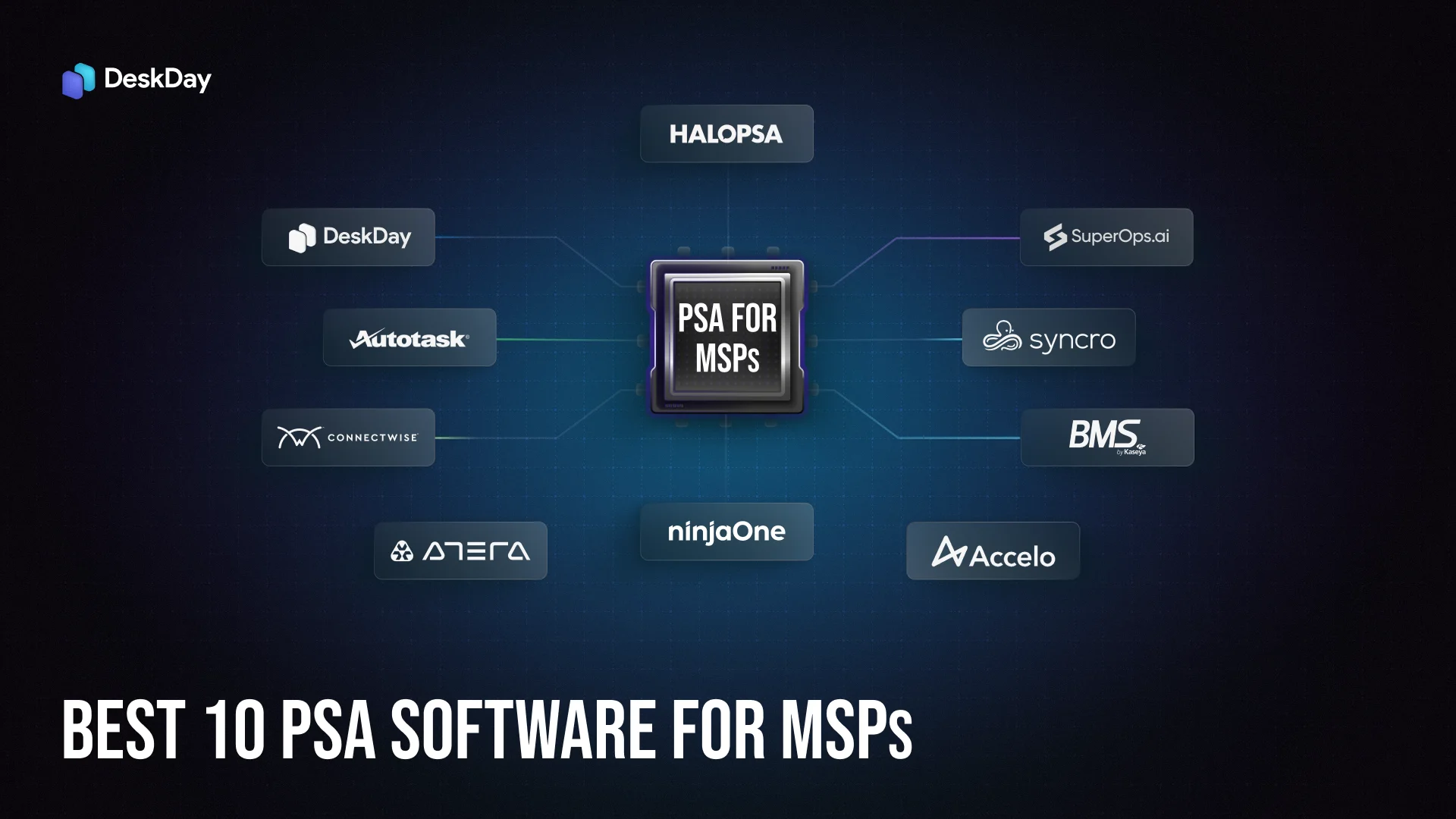
Here are some of the top PSA software and tools that MSPs should consider for 2026:
1.HaloPSA – The best overall option for combining ticketing and automation capabilities (30-day free trial).
2. DeskDay – The world’s first chat-based PSA tool for MSPs, excelling in advanced features, pricing, and user experience (14-day free trial).
3. Atera – The top choice for simple and flexible pricing models (30-day free trial).
4. SuperOps – Outstanding for its advanced ticketing system (21-day free trial).
5. Syncro – Preferred for its user-friendly setup and operation (14-day free trial).
6. ConnectWise PSA – The best in terms of core functionalities and compatibility (contact for trial details).
7. Kaseya BMS – Known for deep integration with the Kaseya IT Complete suite, ideal for MSPs already using their RMM stack (contact for trial details).
8. Autotask PSA (Datto) – A mature, enterprise-grade PSA tool built for scalability and deep ecosystem integration (contact for pricing and trial options).
9. NinjaOne PSA (beta) – While still evolving, NinjaOne’s new PSA module is quickly gaining traction for its seamless tie-in with their top-tier RMM (currently in controlled rollout).
10. Accelo – A service operations platform popular among small IT teams and MSPs for its built-in automation, client portal, and strong project billing features (14-day free trial).
Note: All listed prices are based on a one-year commitment unless specified otherwise.
1. HaloPSA
HaloPSA continues to solidify its position as a leading Professional Services Automation (PSA) solution for Managed Service Providers (MSPs) in 2026. With a strong emphasis on automation, integration, and user-centric design, HaloPSA offers a comprehensive suite of tools to streamline service delivery, billing, and customer engagement.
Key Features & Innovations
AI-Powered Ticket Management: HaloPSA’s AI can now discern between genuine follow-up emails and simple acknowledgments like “Thank you,” preventing unnecessary ticket reopenings and enhancing agent productivity.
Integration Runbooks: These allow for the creation of complex workflows that interact with both internal and external platforms via REST APIs, enabling tasks such as automated user onboarding and offboarding.
Database Lookups: Automate field updates based on SQL queries triggered by specific conditions, offering dynamic data management within the platform.
Gantt Chart Enhancements: Users can now adjust milestones and target dates directly within the Gantt view, facilitating more intuitive project timeline management.
Task Dependencies: Establish dependencies between tasks to ensure seamless project coordination, with automatic adjustments to related task dates upon changes.
NinjaOne Integration: A seamless connection with NinjaOne’s RMM tool allows for synchronized device management and ticketing, reducing manual data entry and improving response times.
Rewst Automation Pack: This integration introduces zero-touch automation for processes like user provisioning in Microsoft 365, license assignments, and account deactivation, significantly reducing technician workload.
Adobe Acrobat Sign Integration: Send quotes directly for e-signature and automatically update records upon approval, streamlining the sales process.
Pro-Rata Invoicing: A new setting allows for pro-rata adjustments in recurring invoices, providing more accurate billing aligned with service delivery.
Asset Type Mapping: Enhanced N-central integration enables more precise asset categorization through customizable mapping rules.
Why Choose HaloPSA?
HaloPSA stands out for its commitment to automation and integration, providing MSPs with tools that not only enhance operational efficiency but also improve client satisfaction. Its continuous updates and user-driven enhancements make it a future-proof choice for service providers aiming to scale and adapt in a dynamic IT landscape.
Considerations
Complex Initial Setup: Due to its immense flexibility and breadth of features, HaloPSA can take time to configure properly. MSPs with smaller teams may need help navigating its modular structure without guided onboarding.
Steep Learning Curve for Custom Workflows: Creating custom workflows, automation logic, and integration runbooks may require internal expertise or dedicated time investment.
Limited Built-In RMM: Unlike platforms like Atera or SuperOps, HaloPSA doesn’t include its own native RMM tool, requiring third-party integration for remote monitoring and endpoint management.
Heavy Feature Depth Not Always Needed: For small or highly focused MSPs, Halo’s enterprise-grade capabilities might feel like overkill compared to more lightweight options like Syncro or DeskDay.
2. DeskDayPSA
DeskDay is revolutionizing Professional Services Automation (PSA) by introducing a chat-first, AI-powered platform tailored for modern Managed Service Providers (MSPs). By integrating real-time communication, intelligent workflow automation, and multi-channel support, DeskDay addresses the evolving needs of MSPs in 2026.
Advanced Service Desk Workflow Automation:Automates ticket assignments, responses, status updates, and billing configurations based on customizable triggers, occasions and actions; reducing manual workload and ensuring timely resolutions.
Multi-Channel End-User Support (IT-Connect): Empowers users to raise tickets and communicate via desktop, mobile, web or Microsoft Teams, ensuring seamless support across platforms.
Integrated Project Management: Offers real-time project tracking, milestone management, and collaborative tools within the chat interface, streamlining project workflows.
Ticket Quality Assurance Framework: Implements rule-based checks across ticketing, projects, and timesheets to maintain service standards and enhance client trust.
Streamlined Billing and Timesheets: Automates time tracking and billing processes, ensuring accuracy and efficiency in financial operations.
Real-Time Announcements: Provides instant notifications for outages, updates, or critical information, keeping both teams and clients informed.
AI-Powered Assistance (Helena AI): Introduces an AI agent to assist with routine tasks, enhancing operational efficiency and reducing response times.
Why Choose DeskDay?
Designed by a long-time MSP partner who deeply understands the industry’s operational pain points, DeskDay reimagines PSA for the modern era. Its chat-first interface delivers a user-centric experience that mirrors how technicians and end users naturally communicate today—fast, contextual, and real-time. Beyond intuitive design, DeskDay offers flexible pricing models that make it accessible for both solo MSPs and scaling teams. With robust integrations—including NinjaOne for RMM, QuickBooks Online forbilling, and N-able N‑central for device visibility—DeskDay ensures a cohesive operational ecosystem, empowering MSPs to deliver efficient, high-quality service without the clutter of legacy systems.
Considerations:
Shorter Trial Window: The current 14-day trial may not offer enough time for larger MSPs to fully explore and implement DeskDay’s extensive capabilities before committing.
Younger Ecosystem: While DeskDay is gaining traction fast, it’s still newer compared to legacy platforms—meaning fewer third-party integrations (though growing) and a smaller community knowledge base.
IT Connect App Scope: While innovative, the IT Connect end-user app is currently optimized for specific support interactions. MSPs looking to include asset views, ticket history or broader self-service modules may find room for expansion.
No Built-In RMM (Yet): While DeskDay offers tight integration with tools like NinjaOne, it doesn’t currently bundle an RMM stack—unlike unified platforms like Atera or SuperOps.
3. AteraPSA
Atera continues to lead in 2026 as a comprehensive platform that seamlessly integrates Professional Services Automation (PSA) with Remote Monitoring and Management (RMM). Designed for Managed Service Providers (MSPs) and IT departments, Atera offers a robust suite of tools to streamline IT operations, enhance efficiency, and drive business growth.
Key Features & Innovations
AI Copilot: Atera’s AI Copilot assists technicians by summarizing issues, suggesting resolutions, and automating routine tasks, thereby reducing response times and enhancing productivity.
IT Autopilot: This autonomous IT agent proactively resolves common issues without human intervention, allowing IT teams to focus on strategic initiatives.
AI Ticket Tagging: Automatically categorizes incoming tickets based on keywords, ensuring efficient routing and quicker resolutions.
Custom Automation Rules: Set up automation rules to handle repetitive tasks, such as sending status updates or assigning tickets, streamlining workflows.
SLA Management: Atera’s revamped SLA workflow allows for precise policy assignments based on contracts, groups, or customer conditions, with flexible logic and priority-based targets.
Robust Integrations: Atera offers seamless integrations with essential IT and business tools, including QuickBooks and Xero, AnyDesk, TeamViewer and more.
Flexible Contracts & Billing: Create various contract types, including hourly, fixed-term, or retainer-based, with customizable rates and automatic time capture for accurate invoicing.
Asset Management: Track and manage hardware and software assets through a centralized dashboard, enhancing visibility and control over IT resources.
Contract Management: Manage client contracts with ease, setting up recurring or one-time agreements, and monitoring SLA compliance to ensure service quality.
Why Choose Atera?
Atera’s all-in-one platform simplifies IT management by combining PSA and RMM capabilities, enriched with AI-driven automation. Its per-technician pricing model offers scalability and cost-effectiveness, making it suitable for MSPs and IT departments of all sizes. With continuous innovation and a focus on user experience, Atera empowers IT professionals to deliver exceptional service while optimizing operational efficiency.
Considerations:
Limited Customization for Complex Workflows: Atera shines in simplicity, but it may not offer the deep automation customization or SLA flexibility expected by advanced or enterprise-level MSPs.
Ticketing System Is Less Sophisticated: Compared to tools like ConnectWise or HaloPSA, Atera’s ticketing module, while functional, lacks deeper queue management and workflow branching.
Limited PSA Granularity: For MSPs wanting full-featured quoting, procurement, or CRM tools within their PSA, Atera’s minimalistic approach might feel too lightweight.
Support Response Times Vary: Some users report slower turnaround on complex support issues, particularly during onboarding or when submitting technical edge cases.
4. SuperOpsPSA
SuperOps is a modern, AI-powered platform that seamlessly integrates Professional Services Automation (PSA) and Remote Monitoring and Management (RMM) functionalities. Designed for Managed Service Providers (MSPs), it offers a comprehensive suite of tools to streamline operations, enhance service delivery, and drive business growth.
Key Features & Innovations
Monica – The AI Copilot for MSPs: SuperOps’ Monica intelligently classifies tickets, recommends resolutions, drafts technician scripts, and continuously learns from support patterns—transforming how techs triage and resolve issues.
Unified PSA + RMM Platform: Built from the ground up with a modern UI, SuperOps combines PSA and RMM into a single interface, enabling faster switching between modules like ticketing, asset management, and automation workflows.
Dynamic Runbooks & Automation Flows: SuperOps allows MSPs to build visual, trigger-based automation workflows for repetitive tasks like patching, onboarding, and maintenance—with full support for conditional logic and script execution.
Proactive Alert Noise Reduction: Uses behavioral analysis to suppress low-priority alerts and bubble up only actionable items, drastically cutting down alert fatigue.
Contract & SLA Intelligence: Smart SLAs can be tied to specific ticket types, clients, or contract tiers, while overage hours, renewals, and expiration triggers are all tracked natively.
Flexible Client Portals: Offers a customizable end-client portal that includes real-time ticket status, contract summaries, and a lightweight self-service knowledge base.
Why Choose SuperOps?
SuperOps stands out by offering a unified platform that combines PSA and RMM functionalities, enriched with AI-driven automation. Its modern interface, customizable workflows, and robust integrations make it an ideal choice for MSPs seeking to enhance operational efficiency and deliver exceptional service.
Considerations:
Still Maturing Ecosystem: While the platform is modern and fast-evolving, it doesn’t yet have the extensive third-party integration marketplace that ConnectWise or HaloPSA boasts.
Smaller Knowledge Base: Given its relative youth, there are fewer community-driven tutorials, templates, or deep-dive documentation compared to more established PSA platforms.
Limited International Support (for now): As of 2025, SuperOps is still expanding region-specific features like tax rules, localization, and compliance for non-US markets.
Feature Roadmap Pace: SuperOps is innovating quickly, but some roadmap features (like deeper billing logic or procurement modules) may still be in development or limited in scope compared to legacy platforms.
5. SyncroPSA
Syncro offers a comprehensive solution for Managed Service Providers (MSPs), integrating Professional Services Automation (PSA) and Remote Monitoring and Management (RMM) functionalities. Its user-friendly interface and automation capabilities make it a preferred choice for small to mid-sized MSPs seeking efficiency and scalability.
Key Features & Innovations
Smart Ticketing System Syncro’s intelligent ticketing system automatically classifies and routes tickets, providing technicians with relevant context and recommended remediation steps, thereby enhancing response times and service quality.
Automated Billing & Invoicing The platform automates the billing process by generating invoices based on customizable factors, ensuring timely and accurate client billing without manual intervention.
Technician Utilization Reporting Introduced in January 2025, this feature offers detailed insights into technicians’ logged time and utilization, enabling MSPs to manage productivity and optimize workflows effectively.
Integrately Integration Syncro now integrates with Integrately, allowing users to connect and automate workflows between different apps and services, enhancing operational efficiency.
AutoElevate Integration The April 2025 update introduced integration with AutoElevate, a Privileged Access Management (PAM) solution, providing smarter user access control and streamlined technician workflows.
Syncro XMM Platform Launched in April 2025, Syncro XMM unifies RMM, PSA, and Microsoft 365 multi-tenant management, simplifying IT management and enhancing security through integration with Microsoft Defender and Entra ID.
Why Choose Syncro?
Syncro is built with simplicity, affordability, and rapid deployment in mind—making it the ideal choice for small MSPs and solo technicians who want a full PSA + RMM suite without enterprise-level complexity. With a predictable, technician-based pricing model and features like automated ticketing, billing, asset tracking, and remote access, Syncro enables fast operational maturity without the overhead.
Considerations:
Cloud-Only Deployment: On-premises environments aren’t supported, which might limit flexibility for MSPs with specific hosting or compliance needs.
Limited Deep Customization: While user-friendly, some advanced MSPs may find limitations in areas like custom workflows or API depth compared to enterprise PSAs.
Smaller Ecosystem: Syncro’s third-party app ecosystem is growing, but it still lags behind platforms like ConnectWise in breadth of integrations and marketplace maturity.
6. ConnectWise PSA
ConnectWise PSA (formerly Manage) is a robust platform designed to streamline business operations for technology service providers. It offers a wide range of features, including ticketing, project management, billing, and CRM, all integrated into a single solution.
Key Features & Innovations
AI-Driven Hyperautomation ConnectWise PSA leverages AI and machine learning to automate routine tasks such as ticket triaging and processing, improving efficiency and allowing teams to focus on strategic initiatives.
ConnectWise Sidekick™ This AI-powered assistant integrates with Microsoft Teams, providing access to PSA records and business insights, thereby enhancing collaboration and decision-making across the organization.
Advanced Project Management Tools The platform offers reimagined project management features, including new work plans, Gantt charts, and Kanban boards, providing greater visibility and usability in project tracking.
Comprehensive Asset Management ConnectWise PSA includes built-in IT inventory and asset management tools, enabling users to track hardware and software assets, manage purchase orders, and maintain accurate inventory across multiple locations.
Integrated Sales and Marketing Tools The platform features robust sales and marketing capabilities, including opportunity management, sales pipeline tracking, and marketing campaign management, facilitating business growth and client acquisition.
Flexible Deployment Options ConnectWise PSA can be deployed either on-premises or hosted in the cloud, catering to businesses with varying infrastructure preferences and compliance requirements.
Why Choose ConnectWise PSA?
ConnectWise PSA (formerly Manage) is a powerhouse platform purpose-built for scaling operations in complex MSP environments. It offers a deep feature set that includes advanced ticketing, procurement, project management, CRM, SLAs, billing, and real-time business intelligence—supported by robust automation through ConnectWise Sidekick™ and hyperautomation workflows.
Considerations:
Steeper Learning Curve: With great power comes complexity—teams often require onboarding time and admin training to fully leverage the platform’s capabilities.
Higher Cost & Resource Requirement: Its rich feature set and modular pricing make it a long-term investment. Not ideal for bootstrapped or solo MSPs.
On-Premise Setup Requirements: For those opting for on-prem deployment, ConnectWise requires Windows Server infrastructure, which may not be feasible for all MSPs.
7. Kaseya BMSPSA
Kaseya BMS is a next-generation Professional Services Automation (PSA) solution designed to help Managed Service Providers (MSPs) and internal IT teams better manage service desks, billing, CRM, and more, enabling them to deliver better services and boost team efficiency.
Key Features & Innovations
AI-Powered SOP Generation Integrated with IT Glue, Kaseya BMS’s Cooper Copilot can generate step-by-step Standard Operating Procedures (SOPs) in real-time, streamlining documentation and reducing manual effort.
Multilingual AI Support Cooper Copilot auto-detects user language preferences, enabling natural, fluent communication across global teams.
Automated IT Billing Kaseya BMS includes billing automation to help eliminate human errors and improve invoice delivery times, ensuring 100% accuracy with zero human resources.
Real-Time KPI Tracking Out-of-the-box dashboards make tracking key performance indicators effortless, allowing more time to be spent on improving business operations.
Why Choose Kaseya BMS?
Kaseya BMS offers a comprehensive suite of tools that streamline IT operations, enhance service delivery, and improve financial management. Its integration with AI-powered features like Cooper Copilot and IT Glue ensures that MSPs can automate routine tasks, maintain accurate documentation, and deliver services efficiently.
Considerations
Learning Curve: While feature-rich, new users may require time to fully leverage all functionalities.
Integration Dependencies: Optimal use may depend on integration with other Kaseya products.
8. Autotask PSA
Autotask PSA is an intelligent IT business management platform that centralizes operations to deliver mission-critical tools needed to run an IT managed services business.
Key Features & Innovations
AI-Driven Ticket Summaries The latest version introduces AI-driven ticket summaries, automatically generating recaps of actions taken on IT service tickets, saving technicians time and improving documentation quality.
UI Refresh The 2025.1 update brings a reimagined user interface designed to modernize, simplify, and empower users, with enhanced navigation, refreshed dashboards, and streamlined worklist panels.
Robust Integrations Autotask PSA integrates with over 200 critical applications, including remote monitoring and management and accounting solutions, providing a single pane of glass view for improved efficiency.
Why Choose Autotask PSA?
Autotask PSA offers a centralized platform that enhances visibility into services, internal operations, customers, and prospects. Its AI-driven features and extensive integrations make it a powerful tool for MSPs aiming to improve service delivery and profitability.)
Considerations
UI Transition: The phased rollout of the new UI may require users to adapt to changes incrementally.
Complexity: The extensive feature set may be overwhelming for smaller teams without dedicated administrative resources.
9. NinjaOne PSA
NinjaOne PSA supports scalability by aligning technical and business operations, providing detailed insights, and automating repetitive tasks, allowing MSPs to grow without added complexity.
Key Features & Innovations
Integrated PSA and RMM NinjaOne combines PSA features with robust remote monitoring and management, offering a unified platform for IT operations.
QuickBooks Online Integration Seamless integration with QuickBooks Online facilitates efficient billing and invoicing processes.
Multi-Currency Support Supports USD, EUR, GBP, and CAD, accommodating diverse financial operations.
Why Choose NinjaOne PSA?
NinjaOne PSA is ideal for MSPs seeking a scalable solution that unifies technical and business operations. Its integrated platform simplifies workflows, enhances visibility, and supports growth without added complexity.
Considerations
Limited Accounting Integrations: Currently, NinjaOne PSA integrates only with QuickBooks Online, which may limit options for some users.
Feature Maturity: As a newer entrant in the PSA space, some features may still be evolving compared to more established platforms.
10. AcceloPSA
Accelo is a cloud-based Professional Services Automation (PSA) platform that helps professional services-based businesses streamline operations, improve efficiency, and scale profitably.
Key Features & Innovations
End-to-End Client Work Management Manages all aspects of client work delivery, from prospect to payment, including sales, projects, tickets, retainers, timesheets, resourcing, and more.
Automated Workflows Offers robust workflow automation tools that simplify processes such as invoicing, client communication, and task assignment.
Multi-Currency Invoicing Enables users to create invoices in various currencies, simplifying international billing and supporting global business operations.
Why Choose Accelo?
Accelo provides a comprehensive solution for managing client relationships, projects, and tasks. Its automation capabilities and real-time insights make it a valuable tool for professional services firms aiming to enhance productivity and profitability.
Considerations
Industry Focus: While versatile, Accelo is primarily tailored for professional services firms, which may limit its applicability for certain MSP-specific needs.
Learning Curve: New users may require time to fully leverage the platform’s extensive features and customization options.
Conclusion: Choosing the Best PSA for Your MSP in 2026
As the MSP landscape continues to evolve in 2026, selecting the right Professional Services Automation (PSA) tool is more critical than ever. With rising client expectations, shrinking margins, and increasing demand for automation and integration, your PSA is no longer just a backend tool—it’s your operational core.
Whether you’re a solo MSP looking for an affordable, all-in-one solution like Syncro or DeskDaypushing the boundaries with AI-driven automation, or a scaling provider seeking enterprise-grade control with ConnectWise, Autotask, or HaloPSA, there’s a platform designed to match your stage of growth and service complexity.
Ultimately, the best PSA for your MSP isn’t just the one with the most features—it’s the one that aligns with your processes, supports your team’s workflows, integrates with your existing tools, and scales as you grow.
Take the time to test, trial, and talk to your peers. The right PSA doesn’t just help you manage—it becomes a catalyst for delivering better service, improving profitability, and growing your business with confidence.
FAQs: Choosing best PSA Software for MSP in 2026
How PSA Software Can Help MSPs in 2026?
PSA tools are shedding their old weight. They’re becoming cleaner, faster, and more AI-driven. Instead of forcing technicians to fight through cluttered menus, modern PSAs streamline ticketing, billing, project work, and customer communication so MSPs can move with more confidence and less friction.
How do I know which PSA is right for my MSP?
Choose the one that feels like it was built for the way you work. It should be easy to set up, simple to use, kind to your technicians, and honest about pricing. If it cuts through your daily chaos instead of adding to it, you’ve found the right one.
What integrations should MSPs expect in 2026?
The essentials: RMM, documentation tools, accounting software, cloud marketplaces, chat systems, and AI assistants. A PSA in 2026 should be the hub—everything else should connect cleanly around it.
Does AI really matter in PSA software for 2026?
More than ever. AI isn’t a gimmick anymore. It lightens the load—drafting replies, tagging tickets, analyzing sentiment, predicting next steps, and spotting issues before they spread. For MSPs, it means quicker resolutions and fewer surprises.
What does a PSA offer for growing MSPs?
As MSPs scale, the chaos scales with them. A PSA gives structure—centralized data, standard processes, automated workflows, and clean reporting. It becomes the scaffolding that supports growth without drowning the team in admin work.
Join our digest
Get exclusive content on the MSP industry and become a part of the DeskDay community.


 Team DeskDay Team DeskDay