 Team DeskDay Team DeskDay
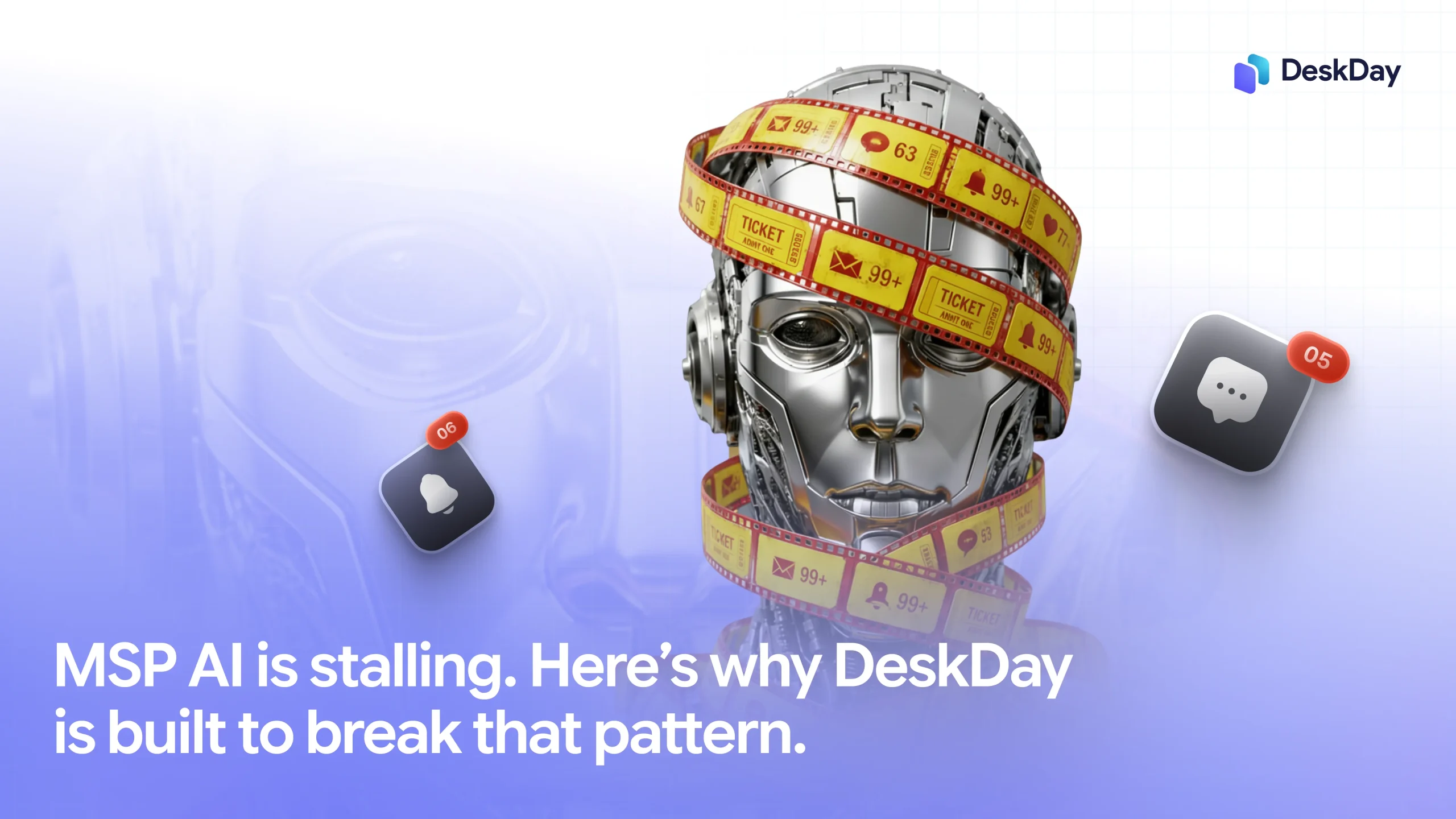
Most MSPs are running AI pilots, buying new tools, and automating workflows, yet the operational transformation they expected still feels out of reach. The problem isn’t effort. It’s architecture. AI bolted on top of disconnected systems produces incremental gains at best. DeskDay was built from the ground up to be different: a unified, AI-native platform where intelligence flows across every part of your MSP operation, not just inside individual silos.
Something is not adding up. MSPs are investing in AI. Vendors are promising transformation. And yet, for most managed service providers, the day-to-day operation still feels like a grind; more tickets, more context-switching, and not enough time in front of clients.
The gap is real, but it is not random. It comes down to a single structural problem: AI tools are being deployed inside silos, not across them. A ticket summarization feature here, a scripting assistant there. Each does something useful in isolation. But none of them talk to each other, and none of them change how the business fundamentally operates.
DeskDay was designed to address this at the root. Not by adding another AI feature to another tool, but by making the entire MSP workflow AI-connective from the start.
When MSPs evaluate AI, the conversation almost always starts in the same place: How do we use this to close tickets faster? How do we reduce tech workload? Those are legitimate questions. But they are also the wrong starting point.
The MSPs pulling ahead are not asking “What can AI automate for me?” They are asking, “What can AI help me do that was previously impossible to deliver at scale?” That is a fundamentally different frame.
The answer to that second question is not faster ticket resolution. It is consistent, proactive client engagement. It is strategic guidance that compounds over time. It is showing up in every customer conversation with full operational context instead of scrambling through three different platforms to find it.
DeskDay shifts the question from “How do we automate support tasks?” to “How do we become the strategic partner every client deserves, at the scale of our entire client base?”
There is a second failure pattern worth naming. AI has made it dangerously easy to build things from scratch. The ability to spin up internal tools that once took months to develop is remarkable, and it is pulling MSP operators down rabbit holes.
We see it regularly: MSPs rebuilding systems they could subscribe to, vibe-coding internal dashboards instead of serving clients, and chasing every interesting use case that surfaces on their feed. The discipline to walk away from an interesting build and ask, “Does this bring in clients or keep them?” is one of the most important leadership skills in this environment.
DeskDay helps MSPs redirect that energy. Instead of building and maintaining custom tooling, operators stay focused on what creates client value. The platform does the heavy lifting so your team can do the work that actually compounds.
Here is what keeps MSP operators up at night: almost every business owner is already running AI experiments inside their organization. They are buying hardware, deploying bots, and automating processes that used to require dedicated teams. And most of them are doing it without their MSP involved at all.
This is shadow AI at scale. And it is happening precisely because MSPs are not proactively entering that conversation. The clients who feel like they have a vendor, not a partner, are not going to wait for their MSP to catch up. They will figure it out themselves, take on risks they do not understand, and then wonder why their IT partner did not flag any of it.
The MSPs who ask “What are you doing with AI and how can we help you do it safely?” win the conversation almost every time.
The hardest part of running an MSP has never been technical. It has always been customer success. Most clients will tell you honestly that they do not feel like they have a strategic partner. They feel like they have a vendor who shows up when something breaks.
That perception is not unfair. Most MSPs spend 90% of their capacity on overhead: ticket management, internal coordination, chasing approvals, and 10% actually engaging with clients in a meaningful way. The result is a relationship defined by incidents, not strategy.
DeskDay flips that ratio. By unifying service delivery, client communication, financial operations, and reporting in a single AI-connected environment, the overhead that once made consistent client engagement impossible is dramatically reduced. Techs spend less time context-switching. Account managers have full client history at their fingertips. Leadership has the visibility to act proactively instead of reactively.
The MSPs who solve this problem do not just look different to their clients, they become genuinely irreplaceable. That is the kind of retention that compounds.
Most MSPs run a PSA, an RMM, a CRM, a quoting tool, a documentation platform, and a finance system. Each requires a separate login. Each holds a separate slice of client context. And AI, when deployed inside any one of them, can only see that slice.
That is why most MSPs are still getting incremental gains from AI instead of transformational ones. Faster ticket summaries, smarter scripting, better reporting; those things matter. But they are improvements happening inside disconnected workflows. The business itself has not changed.
DeskDay addresses this structurally. The platform is not a collection of integrations stacked on top of legacy systems. It is a purpose-built MSP operating environment where data flows freely between service, finance, and client engagement. AI does not have to guess at context because the context is already there.
The concept getting the most traction among forward-thinking MSPs right now is headless operations: running your entire business through a connected AI interface without logging into individual tools. This is precisely the environment DeskDay was designed to enable.
When systems exchange operational context fluidly, AI stops acting like a feature attached to a single platform and starts becoming part of how the business operates. That is the shift from AI as a product feature to AI as the engine behind a scalable services model that compounds over time.
Concretely, here is what that looks like for DeskDay customers:
The operators who are building on a connected, AI-native platform today are not just going to run more efficiently. They are going to show up differently to their clients, more proactive, more strategic, and far more embedded in client decision-making than any reactive vendor could ever be.
That is not a technology advantage. It is a relationship advantage. And relationship advantages are the hardest thing in the market to copy.
The question for every MSP operator right now is simple: Are you using AI to do the same things slightly faster, or are you using it to do things that were previously impossible to deliver consistently at scale? DeskDay exists to make the second answer achievable.

Get exclusive content on the MSP industry and become a part of the DeskDay community.