
Datto RMM + DeskDay is live now! If you're a Datto RMM user, sign up today to claim your free trial Get Started

 Team DeskDay Team DeskDay
Modern MSPs don’t struggle because they lack tools. They struggle because their tools don’t talk.
You’ve got an RMM watching endpoints, an accounting system tracking revenue, a ticketing platform logging issues, maybe a documentation tool on the side, and a few scripts quietly holding everything together. Each one does its job. Yet between them sits a messy layer of manual work, duplicated data, missed syncs, and technicians switching tabs more often than they switch tasks.
The real bottleneck isn’t capability. It’s a connection.
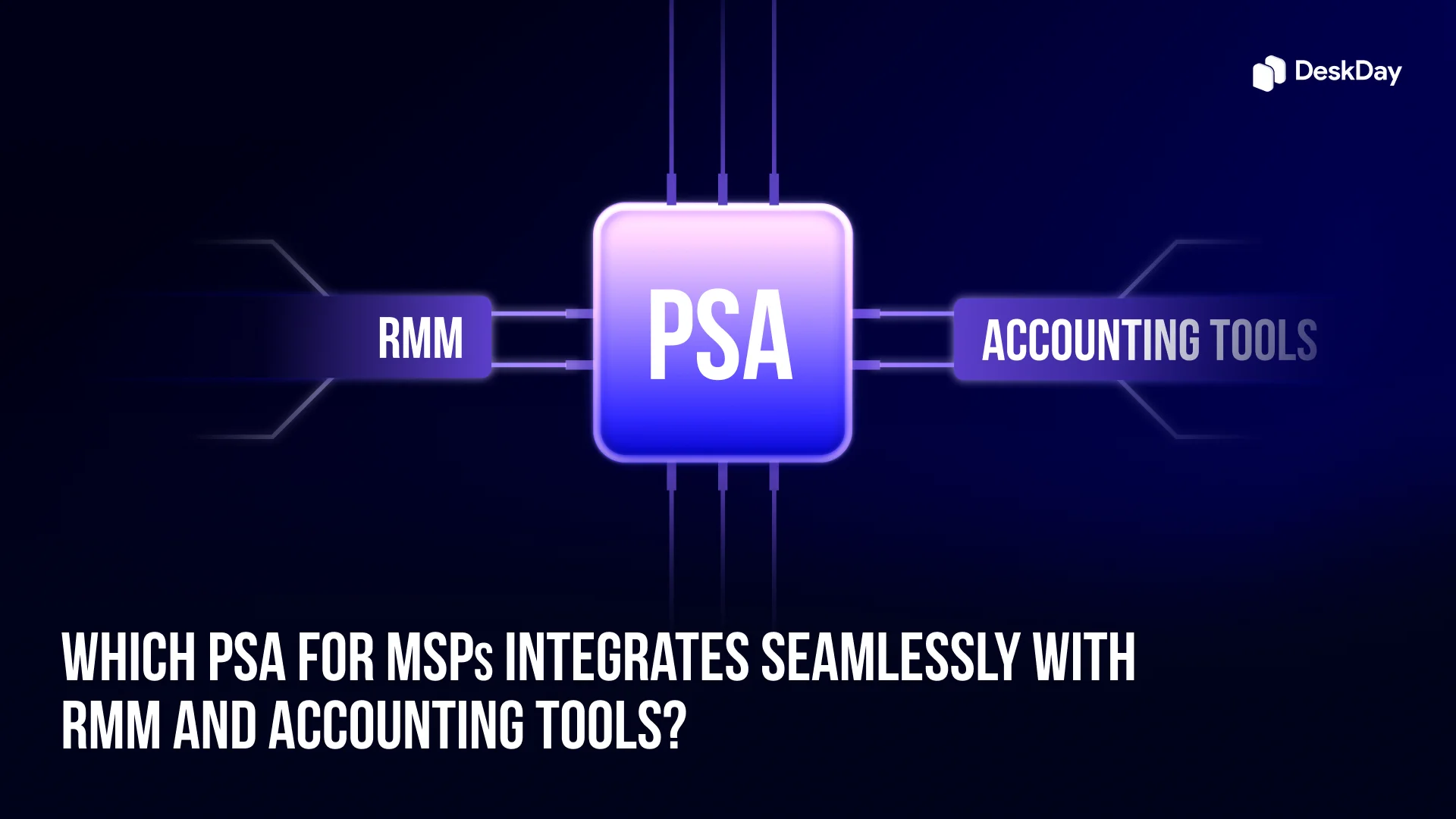
An MSP stack typically revolves around three core systems:
When these systems operate in isolation, the cracks start to show.
Alerts get generated but aren’t mapped cleanly to tickets. Tickets are resolved, but time entries don’t always align with contracts. Invoices are created but require manual exports, reformatting, or adjustments before they land in accounting.
The result? Technicians spend time validating data instead of solving problems. Finance teams double-check exports instead of reviewing margins. Owners don’t fully trust the numbers because too many steps happen in between.
A connected stack isn’t a luxury anymore. It’s operational oxygen.
A PSA built for modern MSPs should act as the operational nerve center, not just a ticket repository. It should:
That means deep integrations with leading RMM and accounting platforms, not surface-level connectors that simply push raw data across.
Let’s look at what that looks like in practice.
When your RMM fires an alert, the workflow should be immediate and structured.
NinjaOne is known for clean monitoring and automation. But when alerts need context, ticketing must respond intelligently. A strong PSA integration ensures alerts are automatically mapped to the right customer, device, and site, complete with priority, SLA, and contract alignment, without a technician manually filling in gaps.
N-central environments often manage complex, multi-site infrastructures. Here, device mapping and policy-based ticket creation are critical. The PSA should recognize the asset, associate it with the correct contract, and route it to the right technician group without friction.
With Datto RMM generating automated remediation scripts and system alerts, the PSA must reflect those actions clearly, linking tickets back to devices and maintaining a traceable history that aligns with billing logic.
For MSPs running Level RMM, speed and simplicity matter. Alerts should turn into actionable tickets instantly, while maintaining clean device-to-customer relationships so reporting and invoicing remain accurate.
When RMM and PSA operate as one flow instead of two parallel systems, technicians stop babysitting alerts and start solving problems.
The second half of the stack is financial integrity.
Resolving tickets is only half the job. Billing them correctly, consistently, and without manual cleanup is what protects margins.
For MSPs using QuickBooks Online, invoice sync must be structured. That means customers, tax rules, payment terms, and invoice views are mirrored correctly. A PSA should generate invoices that land in QuickBooks without rework, maintaining contract alignment, tax configuration, and service fee logic.
Xero users expect clarity and clean reconciliation. The PSA should push invoices, credit notes, and payment updates in a way that preserves financial reporting accuracy. No CSV gymnastics. No manual tax corrections. Just synchronized data reflecting the actual work performed.
When PSA and accounting are fully connected, finance teams gain real-time visibility into revenue, recurring contracts, prepaid hours, and overages without chasing spreadsheets.
When RMM, PSA, and accounting operate in sync:
That continuity removes silent friction across the organization. Technicians feel less cognitive load. Operations managers gain clearer SLA and workload visibility. Finance teams trust billing outputs. Owners see cleaner revenue data.
The entire business runs more smoothly because the systems behave like one ecosystem instead of a loose collection of tools.
This is where DeskDay was designed to operate.
Rather than acting as just another PSA layered on top of your stack, DeskDay focuses on becoming the operational bridge between RMM alerts and accounting outcomes, ensuring that integrations with NinjaOne, N-able N-central, Datto RMM, and Level RMM convert monitoring signals into structured tickets that respect contracts, SLAs, and device mappings from the start.
On the financial side, DeskDay integrates with QuickBooks Online and Xero so invoices generated from ticket time entries, recurring contracts, or block hour consumption flow directly into accounting, preserving tax configurations, billing addresses, payment terms, and financial reporting structures without requiring manual intervention.
The goal is simple, though the execution demands depth: eliminate the operational gaps between monitoring, service delivery, and revenue recognition.
When your PSA truly connects the stack, your team stops managing systems and starts managing service.
And that’s the difference between a toolset and an ecosystem.
With DeskDay at the center, you can build combinations that match your operational style:
Monitoring, service delivery, and accounting tightly connected.
A lightweight, high-efficiency stack built for speed and financial clarity.
Deep device monitoring aligned directly with contract billing and finance.
Automated remediation, structured ticketing, and clean invoice sync.
You are not locked into a rigid ecosystem. You design the stack. DeskDay connects it.
And when your PSA truly integrates across monitoring, documentation, and accounting, your operations stop feeling stitched together and start functioning as a single, intelligent system.

Get exclusive content on the MSP industry and become a part of the DeskDay community.


