 Team DeskDay Team DeskDay
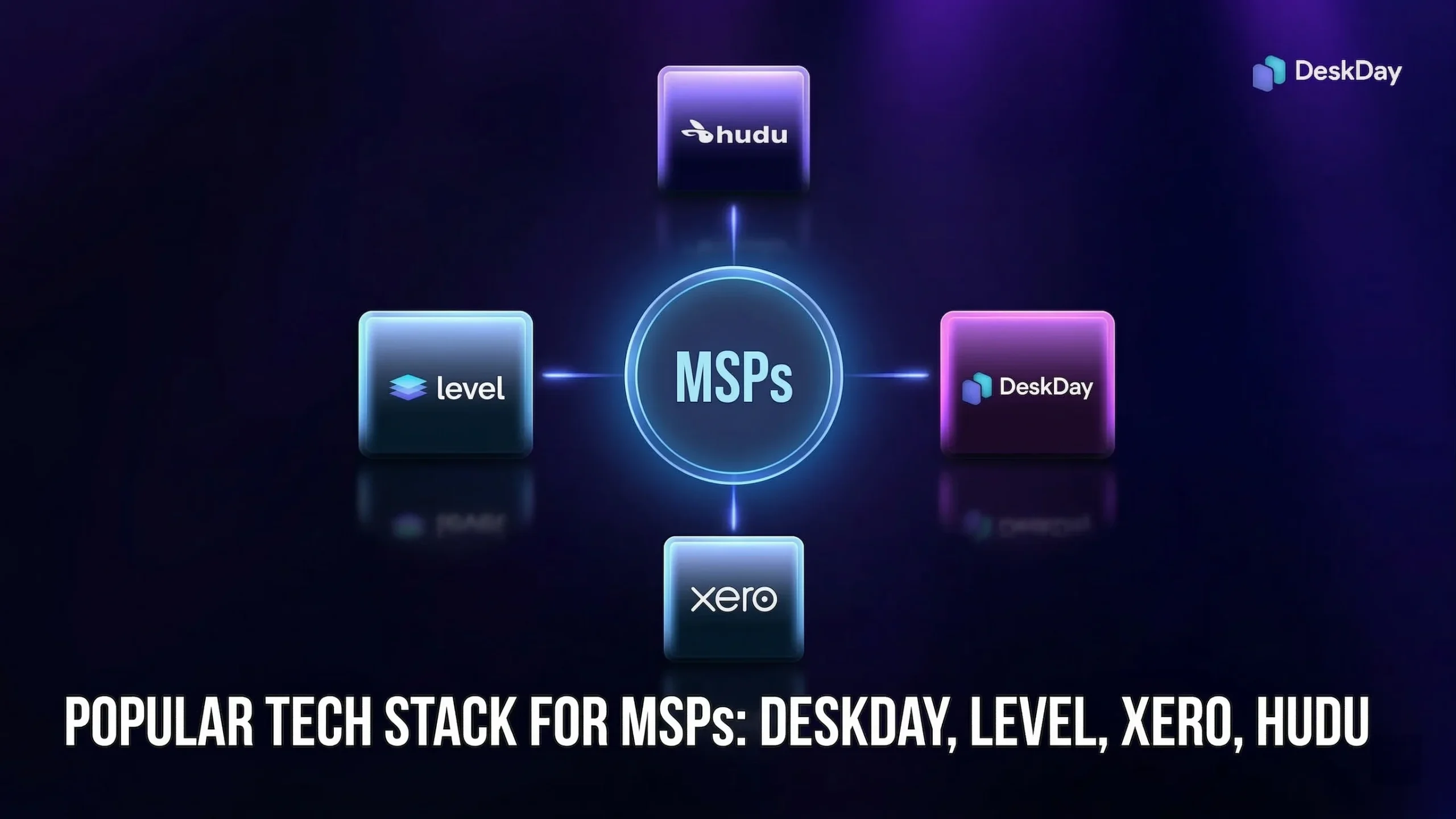
As Managed Service Providers (MSPs) juggle growing client bases, complex multi-tenant environments, and 24/7 uptime demands, fragmented tools create silos that breed inefficiency. Think manual data transfers, duplicated efforts, and delayed resolutions that erode profitability.
A unified stack like DeskDay-Level-Xero-Hudu addresses this by enabling seamless data flow, automating repetitive tasks, and providing a single pane of glass for operations, ultimately slashing mean time to resolution (MTTR) by up to 40% and boosting billable utilization.
DeskDay stands out as the ideal Professional Services Automation (PSA) core for MSPs because it reimagines ticketing as a conversational, AI-enhanced experience rather than rigid forms. Its chat-first interface integrates natively with multiple channels for end-users including Microsoft Teams, mobile, desktop, and web, allowing technicians to handle tickets via familiar channels which reduces adoption friction and keeps support centralized. This is critical for MSPs managing high-volume, multichannel inquiries without overwhelming techs.
Helena, DeskDay’s AI engine, takes this further by automating ticket triage: it analyzes incoming tickets for sentiment (e.g., urgency detection), drafts context-aware responses, and even suggests relevant past ticket resolutions and KBs, freeing techs for high-value work.
For MSPs scaling beyond 50 clients, built-in project management tracks recurring contracts and resource allocation, while native billing modules calculate time-based or fixed-fee charges directly from tickets, ensuring revenue capture without export hassles.
This combination makes DeskDay not just a ticket tool but a profitability engine, as it embeds AI to predict escalations and optimize workflows, helping small to mid-market MSPs compete with enterprises on efficiency alone.
Remote Monitoring and Management (RMM) tools like Level are essential for MSPs to shift from reactive firefighting to proactive prevention, and Level excels by prioritizing simplicity and speed in endpoint management.
Unlike legacy RMMs bogged down by clunky UIs, Level offers intuitive dashboards for multi-client oversight, automated patching across Windows, macOS, and Linux, and real-time scripting, allowing MSPs to standardize maintenance without deep scripting expertise.
For MSPs, this means faster issue detection: Level’s agent-light design deploys quickly to thousands of devices, monitors performance metrics like CPU spikes or disk failures, and triggers custom alerts tailored to client SLAs. Its multi-tenancy ensures strict data isolation, preventing cross-client leaks, while features like remote desktop access and software deployment keep technicians productive without VPN hassles: ideal for lean teams servicing diverse SMBs to enterprises.
Ultimately, Level empowers MSPs to deliver “VIP service at scale,” reducing downtime risks and enabling upsell opportunities like cybersecurity add-ons through its extensible scripting and API.
Xero is a game-changer for MSPs’ financial operations because it transforms accounting from a monthly chore into real-time visibility, with PSA-friendly features like automated bank feeds and customizable invoicing that align perfectly with service-based billing. MSPs benefit from its cloud-native design, which supports multi-currency for global clients and handles complex revenue recognition for subscriptions or retainers, ensuring compliance without spreadsheets.
Key for MSPs is Xero’s reconciliation automation: it matches bank transactions to invoices instantly, flags discrepancies, and generates reports on cash flow or AR aging which is vital for spotting unbillable gaps early.
Integration-ready APIs pull time entries directly into line items, applying taxes or discounts per contract, which cuts month-end closes from days to hours and minimizes errors that plague 70% of manual billing processes.
By focusing on scalability, Xero lets MSPs forecast revenue accurately, secure financing with clean books, and reinvest savings into growth rather than back-office drudgery.
Hudu revolutionizes MSP documentation by providing a modern, client-portal-ready knowledge base that’s both standardized for internal teams and customizable for per-client needs, solving the chaos of scattered SOPs, passwords, and configs. For MSPs, its asset tracking ties devices, passwords, and procedures into a searchable wiki, with templates ensuring consistency across 100+ clients while allowing branded client views; reducing onboarding time from weeks to days.
Security is paramount: Hudu encrypts sensitive data, supports MFA, and audits access, making it compliant for MSPs handling regulated industries like healthcare. Techs query articles via natural language, attach files to assets, and export reports for audits, turning documentation from a compliance burden into a resolution accelerator that boosts first-time fix rates.
This makes Hudu indispensable for knowledge retention in high-turnover MSP environments, preserving tribal knowledge and enabling self-service for clients to cut ticket volume.
DeskDay-Level-Xero-Hudu stack creates a closed-loop ecosystem where data flows bidirectionally through DeskDay, ensuring techs never leave their central hub. Here’s the granular breakdown of tickets, alerts, invoices, documents, and billing in action:
Level’s real-time monitoring detects issues like a disk failure or malware alert and instantly triggers alerts to DeskDay, auto-generating a high-priority ticket pre-populated with device details, client context, and alert history. Techs open the ticket in DeskDay and launch Level’s remote session with one click; no app-switching or credential juggling; directly diagnosing and scripting fixes right from the ticket interface.
Upon resolution (e.g., patch applied, reboot confirmed), DeskDay auto-closes the ticket if metrics normalize; this proactive loop prevents ticket backlog and ensures SLAs are met without follow-ups.
For both Level alerts and support tickets, DeskDay’s AI service desk assistant, Helena queries Hudu in real-time, surfacing relevant SOPs, configs, or passwords right within the ticket pane. Techs access or attach Hudu articles to tickets without leaving DeskDay, with changes syncing back to Hudu for team-wide updates and knowledge refinement.
This embeds tribal knowledge dynamically, boosting first-contact resolutions by 30-50% as techs resolve faster with full context, whether it’s a server SOP from an alert or troubleshooting steps for a user ticket.
DeskDay’s has time tracking within tickets, projects and activities, logging billable time against multiple contracts or fixed fees. Resolved tickets compile time entries into draft invoices, including line items, taxes, and discounts, which sync to Xero instantly via bi-directional API, populating accurate financials without CSVs or re-entry.
Xero processes payments, reflecting status back to DeskDay.
This frictionless integration automates 80% of admin, empowers lean MSP teams to scale profitably, and transforms support into a revenue driver.
Book a demo to explore this stack further.

Get exclusive content on the MSP industry and become a part of the DeskDay community.